

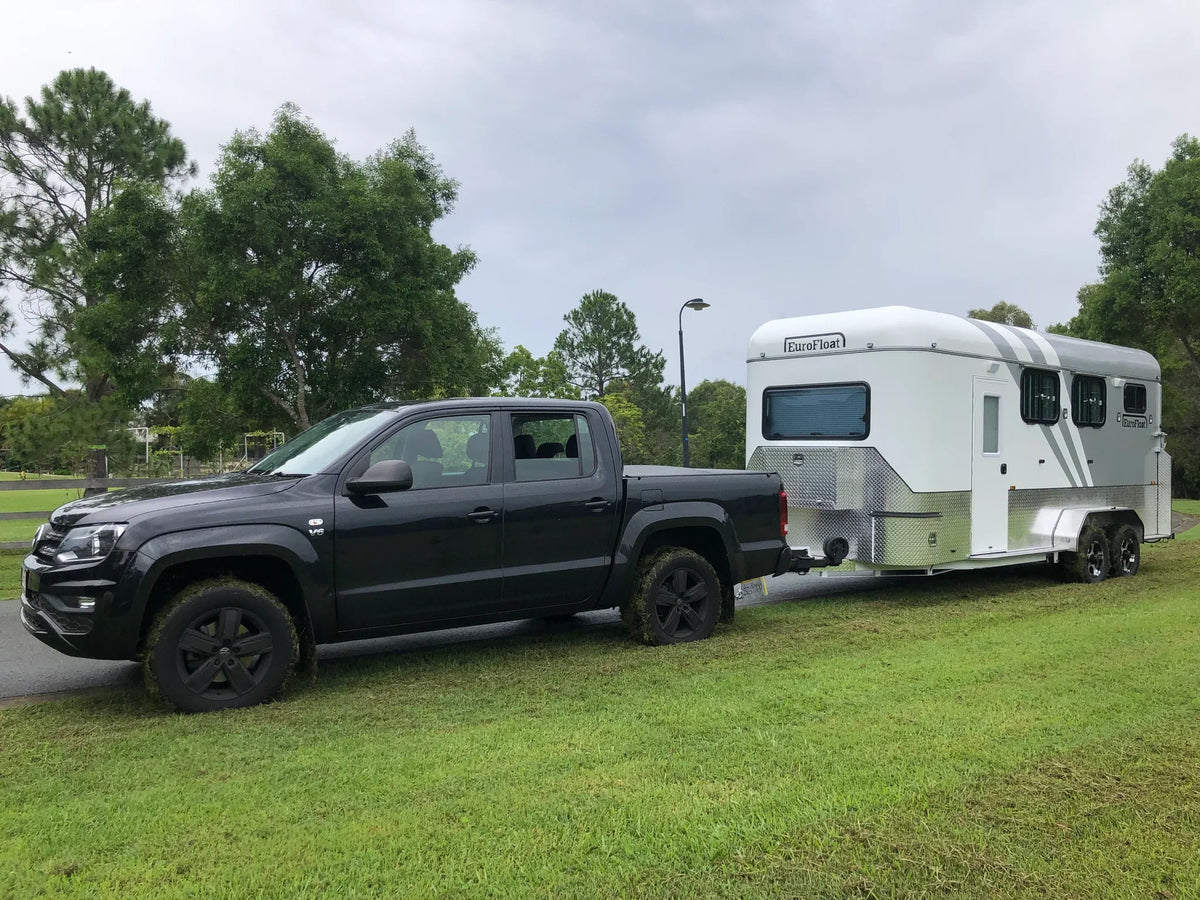
Horse float weight depends on the model, its equipment and what you're carrying. A EuroFloat 2 Horse Straight Load S RN Classic has a listed tare of 1,265 kg and ATM of 2,950 kg. A 3 Horse Transporter SN lists 1,975 kg tare and 3,800 kg ATM. Tare is the empty float's listed weight; ATM is its maximum permitted loaded weight. Horses, water, gear and upgrades all count. Always check the compliance plate on your actual float and your vehicle's towing limits.
In this guide10 sections
- What do horse float weight figures actually mean?
- How much does a 2 horse float weigh?
- How much does a 3 horse float weigh?
- How much does a camper float or gooseneck weigh?
- Do upgrades change a horse float's tare weight?
- Do horses, water and equipment all count towards ATM?
- What about tow ball weight and the towing vehicle?
- How can you check the real weight before towing?
- Why does comparing actual horse float weights matter?
- Questions buyers ask
G'day, Wes here. Horse float weights are one of the first things I want people to understand before buying. Two floats can look much the same but weigh quite differently. Once you add your horses, water and gear, those differences matter.
What do horse float weight figures actually mean?
When you're looking at a horse float, you'll usually see two important numbers: tare and ATM. You might also see GTM, payload and tow ball weight. They're all connected, but they don't mean the same thing.
- Tare weight. The weight of the float empty, under the manufacturer's stated tare conditions. EuroFloat's published figures are for floats fully fitted with their standard equipment, without optional upgrades.
- ATM (Aggregate Trailer Mass). The maximum permitted weight of the fully loaded float, including the weight carried through the coupling.
- Payload. The difference between ATM and tare. It's your starting allowance for horses, tack, water, feed and anything else added to the float.
- GTM (Gross Trailer Mass). The weight carried by the trailer's wheels when it's coupled and loaded. It doesn't include the load carried by the tow vehicle through the coupling.
- GVM (Gross Vehicle Mass). The maximum permitted loaded weight of the towing vehicle.
- GCM (Gross Combination Mass). The vehicle manufacturer's maximum permitted combined mass of the towing vehicle and trailer.
These figures matter because your float and tow vehicle each have their own limits. Staying under the float's ATM doesn't automatically mean your vehicle can legally tow it.
The other thing to remember is that a website tare figure isn't necessarily the weight of the exact float sitting in front of you. Options can change it. The compliance plate and the actual loaded weight are what you need to check.
Read my pre-tow checklist for the checks I recommend before travelling.
How much does a 2 horse float weigh?
There isn't one weight for every 2 horse float. A straight load, angle load and camper float can have very different layouts and equipment.
Here's a selection from our range. These figures are as listed on the EuroFloat website, not independently checked against each float's compliance plate.
| EuroFloat 2 horse model | Tare | ATM | Listed payload calculation |
|---|---|---|---|
| Straight Load S RN Classic | 1,265 kg | 2,950 kg | 1,685 kg |
| Straight Load S Plus RN | 1,400 kg | 3,400 kg | 2,000 kg |
| Straight Load Camper L600 WB SN | 1,700 kg | 3,500 kg | 1,800 kg |
| Angle Load S SN | 1,700 kg | 3,500 kg | 1,800 kg |
| Angle Load S Plus SN | 1,800 kg | 3,500 kg | 1,700 kg |
| Angle Load Camper L860 SN | 1,875 kg | 3,500 kg | 1,625 kg |
| Compact Overnighter 2.1 | 2,100 kg | 3,500 kg | 1,400 kg |
| Mid Overnighter 2.1 | 2,200 kg | 3,800 kg | 1,600 kg |
| Ultimate Overnighter 2.1 | 2,400 kg | 3,950 kg | 1,550 kg |
The payload column is simply ATM minus tare, calculated from the published numbers. It isn't a promise that you can add that amount to every particular float.
Take the Straight Load S RN Classic as an example. Its listed tare is 1,265 kg, and its ATM is 2,950 kg. Subtract one from the other and you get 1,685 kg.
That allowance has to cover everything you add after the standard tare condition. It isn't a separate allowance for horses plus another allowance for equipment.
It's also worth noticing that a more expensive or more heavily equipped float doesn't automatically have more payload. Look at the actual figures, not just the number of horses on the name.
How much does a 3 horse float weigh?
A 3 horse float needs enough room for three horses, but the weight still varies depending on the model and what else is fitted.
Our 3 Horse Transporter SN is listed at 1,975 kg tare and 3,800 kg ATM. The L500 camper model carries additional accommodation equipment, so it's important to check its figures separately.
| EuroFloat 3 horse model | Tare | ATM | Listed payload calculation |
|---|---|---|---|
| 3 Horse Transporter SN | 1,975 kg | 3,800 kg | 1,825 kg |
| 3 Horse Camper L500 SN | 2,175 kg | 3,800 kg | 1,625 kg |
| Ultimate Overnighter 3.1 | 2,550 kg | 4,500 kg | 1,950 kg |
| 3 Horse Gooseneck SN 3.1 | 2,900 kg | 4,500 kg | 1,600 kg |
All figures are as listed on our website. Actual compliance plate details take priority.
One thing that catches people out is the difference between carrying three horses and having enough remaining weight allowance for three horses.
You need to know the combined weight of the horses you're planning to carry, along with the equipment and supplies travelling with them.
Don't assume that because a float has three bays, every combination of three horses and their gear will fit within its permitted weight.
How much does a camper float or gooseneck weigh?
A camper float or horse float with living gives you more equipment for shows and nights away. That generally means more items to include in your weight calculations.
Our 2 Horse Gooseneck Camper SN 2.1, for example, is listed at 2,700 kg tare and 4,200 kg ATM. Its calculated starting payload is 1,500 kg.
The 3 Horse Gooseneck Camper SN 3.1 lists 2,900 kg tare and 4,500 kg ATM, giving a calculated starting payload of 1,600 kg.
Compare those with the Compact Overnighter 2.1 at 2,100 kg tare and 3,500 kg ATM. They're different floats with different equipment, so the weight limits need to be checked individually.
Living equipment also adds another consideration: what you load after buying.
A fridge full of supplies, water, clothing, feed and camping gear all need to be allowed for. The larger the trip, the easier it is to keep adding small things without thinking about their combined weight.
Our Overnighter and gooseneck ranges have their own layouts and equipment. See our horse floats with living to compare the models before deciding what suits you.
Do upgrades change a horse float's tare weight?
Yes. This is one of the main reasons I don't want buyers relying on the tare figure from a basic model when they're looking at a float fitted with extras.
Our published tare figures are for the standard specification without optional upgrades.
If you're adding an awning, battery system, air conditioning, yards or other equipment, those additions have weight. The amount depends on the actual equipment fitted.
A float's finished weight can therefore be different from the base figure on a website.
Here's what I'd ask before finalising an order:
- Which options are fitted? Make a complete list rather than relying on the model name.
- What does the tare include? Ask whether the stated figure reflects the actual float with those options.
- What has been added since delivery? Owners sometimes add storage, equipment or accessories later.
- What is the actual loaded weight? If there's any uncertainty, get the float weighed properly.
- How much allowance remains? Recalculate it from the weight of the actual float and the applicable ATM.
You don't want to find out after loading two horses and a weekend's gear that the allowance isn't what you expected.
Do horses, water and equipment all count towards ATM?
They do. Everything carried by the float contributes to its loaded weight.
That means horses, saddles, bridles, rugs, feed, tools, spare equipment, water and whatever else you pack.
Here's a simple worksheet you can use before travelling.
| What you're allowing for | Weight to enter |
|---|---|
| Actual float weight with fitted options | ______ kg |
| Horse 1 | ______ kg |
| Horse 2 | ______ kg |
| Horse 3, if applicable | ______ kg |
| Water carried | ______ kg |
| Tack, rugs and feed | ______ kg |
| Other equipment and supplies | ______ kg |
| Total loaded weight | ______ kg |
Start with the weight of your actual float, not an assumed base tare. Add the rest and compare the total with the ATM on the float.
Then check the vehicle's towing and combination limits separately.
If you're not sure what a horse weighs, arrange a suitable measurement rather than guessing. The same goes for equipment and water.
This matters particularly for people travelling to competitions. It's easy to pack the float over several days, add the final bits on the morning and never work out the total.
I would rather see someone spend a little time doing the sums before a trip than find out on the road that they've overloaded their float.
What about tow ball weight and the towing vehicle?
There's another part to the calculation. Not all the float's weight sits on its wheels.
On a conventional ball-coupled float, some of the loaded weight is carried by the tow vehicle through the coupling. This is called tow ball download.
It affects the load on your towbar and the available payload of your vehicle.
Our spec sheets list a tow ball weight of 175 kg for the 2 Horse Angle Load S, and 275 kg for the L860, the Overnighters and our 3 horse angle loads. Those are spec figures, not a measurement of your float once it's loaded.
We don't publish a tow ball figure for our straight loads or goosenecks, so ask us about the float you're looking at rather than guessing.
Actual coupling loads change with loading and must be checked for the specific combination.
Before towing, check:
- Vehicle towing capacity. The manufacturer's rating for your particular vehicle.
- Towbar and coupling ratings. Both must be suitable for the load.
- Tow ball download. Check the actual loaded value against all applicable limits.
- Vehicle GVM. Passengers, luggage and coupling load affect the vehicle.
- Vehicle GCM. The combined mass must stay within the manufacturer's limit.
- Float ATM and GTM. Both must remain within their stated ratings.
A vehicle advertised with a certain towing capacity doesn't automatically have enough remaining payload or GCM allowance for your particular float.
For a closer look at choosing a tow vehicle, read what can tow a horse float.
How can you check the real weight before towing?
Start with the identification and compliance information on your float, then check what the finished float actually weighs.
If you've added equipment, don't assume the original tare still applies.
A weighbridge or suitable professional weighing service can help establish the loaded mass. Make sure the method also accounts for how the trailer's load is shared between its wheels and coupling.
I would work through these checks:
- Find the ATM and other ratings on the float's identification plate.
- Confirm the weights and limits in your towing vehicle's handbook.
- Check the rating of the towbar, hitch and coupling.
- Include every upgrade and item you're carrying.
- Check the actual loaded mass and coupling load.
- Stay within the applicable float and vehicle limits.
Keep the records somewhere you'll find them. You'll be glad you have them when you change vehicles or start carrying different horses.
The figures on our model pages are a starting point. The actual float, in its actual loaded condition, is what matters.
Why does comparing actual horse float weights matter?
Two floats can look similar, have the same number of bays and still have different tare and ATM figures.
One might have a different layout, more equipment or a different permitted maximum weight. That changes what you can carry and what sort of vehicle combination you need.
When you're comparing floats, ask for both tare and ATM. Don't accept a statement that a float is light without asking what that means.
At EuroFloat, we publish tare and ATM on our model pages so you can start comparing before you visit. I still want you to check the finished float and your own towing setup.
A horse float needs to work for the horses you actually carry and the journeys you actually make.
I'd always choose the right combination of space, equipment and legal loading capacity over a number that sounds impressive.
"It towed perfectly straight it was rock solid on the road."
Michael Davidson, Google review ★★★★★
Questions buyers ask
What is the difference between tare and ATM?
Tare is the float's empty weight under its stated conditions. ATM is the maximum permitted mass of the fully loaded float, including the load carried through the coupling.
How much does a 2 horse float weigh?
It depends on the model. As listed, EuroFloat's 2 Horse Straight Load S RN Classic has a tare of 1,265 kg, while the Ultimate Overnighter 2.1 is listed at 2,400 kg. Check the actual float's compliance plate.
How much does a 3 horse float weigh?
As listed, the EuroFloat 3 Horse Transporter SN has a tare of 1,975 kg and ATM of 3,800 kg. Other 3 horse models have different figures, especially those with living equipment.
Does an awning add to the weight of a horse float?
Yes. An awning adds weight, just like a battery, air conditioning system or other upgrade. Include the fitted equipment when calculating what the float can carry.
Can I use the website tare to work out my towing capacity?
Use it as a starting point only. Check the actual float's weight and ratings, then confirm your vehicle's towing capacity, towbar rating, payload and GCM.
What if I'm close to the maximum permitted weight?
Don't rely on estimates. Have the loaded combination weighed using a suitable method and check every applicable rating before towing.
Know your weights before choosing
Compare the tare and ATM of our range, then ask us about the models that suit your horses and vehicle.


Figures are as listed by EuroFloat in October 2026 and are not compliance-plate verified for individual floats. Always check the actual float, loaded weights and towing vehicle limits before travelling.
