

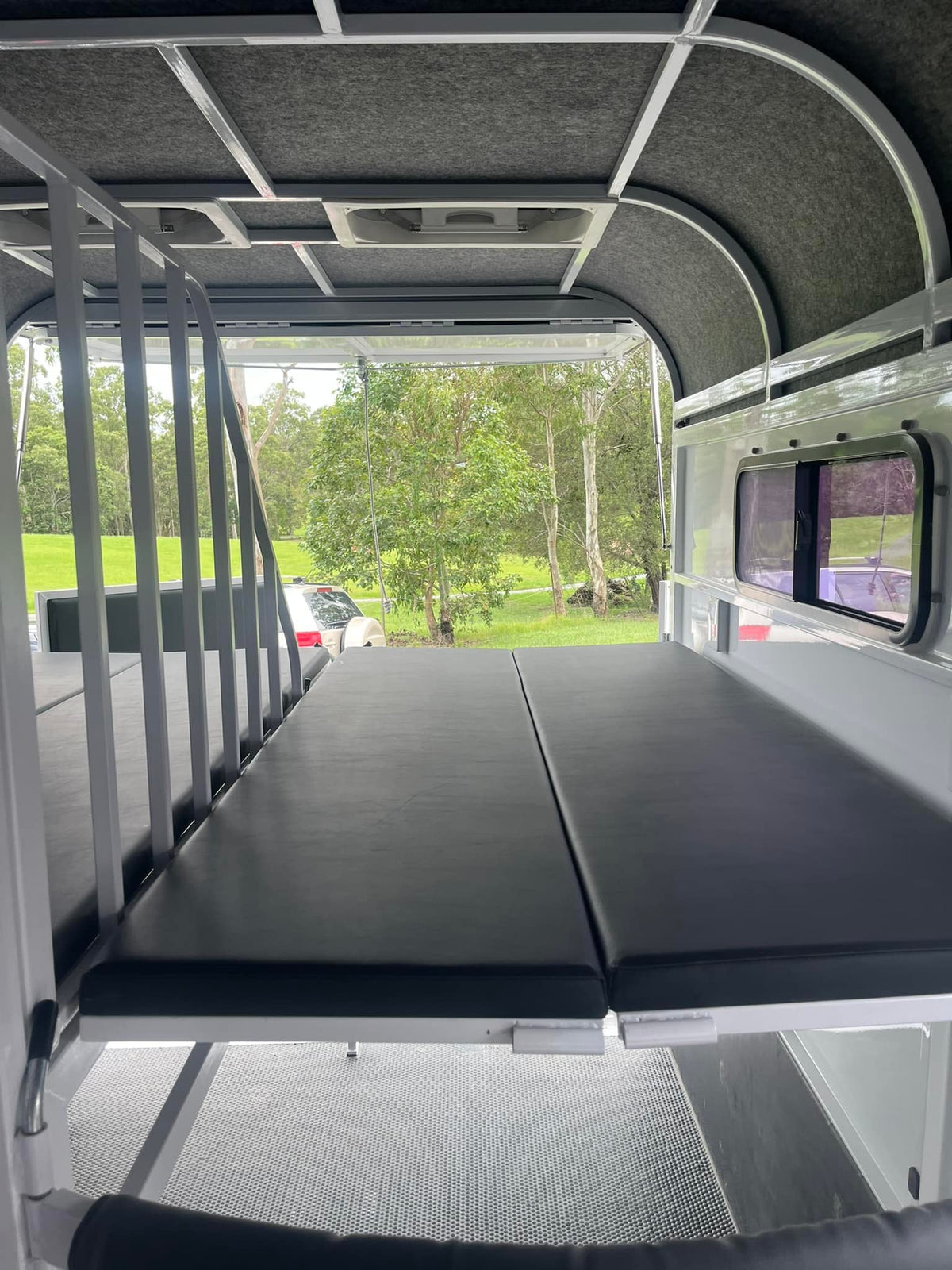
Horse float dimensions matter more than the number of horses on the model name. Compare the usable bay length, width and internal height with your horse's actual measurements. As listed, EuroFloat's 2 horse straight load bays range from 1,900 to 2,100 mm long, while its 2 horse angle load bays range from 2,400 to 2,600 mm. Internal height varies by model. Measure your horse standing naturally, then check the real space inside the float, including dividers and padding, before deciding whether it fits.
In this guide9 sections
- Which horse float dimensions actually matter?
- What are the dimensions of a 2 horse straight load float?
- What are the dimensions of a 2 horse angle load float?
- How much room does a 3 horse float provide?
- How do you measure your horse before choosing a float?
- Does a horse's height in hands tell you what float to buy?
- Do Overnighter and gooseneck floats have different bay sizes?
- What should you check when you inspect a horse float?
- Questions buyers ask
G'day, Wes here. One of the first things people tell me is how many hands their horse is. That's useful, but it doesn't tell me everything about how much room they need in a float. I want to know their build, length and how they stand as well.
Which horse float dimensions actually matter?
When you're comparing horse floats, start with the space the horse will actually use.
A float can have generous outside dimensions but still have a bay that doesn't suit your horse. The layout, dividers, padding and fittings all affect how much usable room there is.
There are three measurements I want you to look at first.
- Bay length. The space allocated along the horse's standing position. Check where that measurement starts and finishes.
- Bay width. The room the horse has between the divider and the surrounding surfaces.
- Internal height. The clearance inside the horse area, not the outside height of the float.
Then look at the shape of the bay. A straight load and an angle load arrange the horses differently, so their measurements aren't always directly comparable.
A longer advertised bay doesn't automatically give your particular horse more usable room. The dividers and layout matter as well.
I also want you to look at where the horse's head sits, how the rump bar is positioned and whether the horse has enough room to stand naturally.
If you're comparing different brands, ask them to show you exactly how they measure their bays. It makes a big difference when you're looking at numbers on a website.
What are the dimensions of a 2 horse straight load float?
Our 2 horse straight load range includes different bay sizes. That gives you a choice depending on your horse's build and the layout you want.
Here are three examples from our listed specifications.
| EuroFloat straight load model | Bay length | Bay width | Internal height |
|---|---|---|---|
| 2 Horse Straight Load S RN Classic | 1,900 mm | 700 mm | 2,200 mm |
| 2 Horse Straight Load S Plus RN | 2,100 mm | 800 mm | 2,200 mm |
| 2 Horse Straight Load Camper L600 WB SN | 2,100 mm | 900 mm | 2,250 mm |
These are website-listed measurements. They haven't been checked against the individual float being delivered.
The S Plus has a longer and wider listed bay than the S RN Classic. The L600 WB camper has a wider listed bay again.
That doesn't mean every horse will prefer the widest option. You still need to think about how your horse stands and where the centre divider sits.
When you're looking at a straight load, check both bays individually. The centre divider is part of the layout, and the usable space needs to suit the horse travelling in that position.
Also check the head area and the ramp arrangement. Don't judge the whole float on one number.
A straight load can be a sensible choice for people who like horses travelling facing forward. It's worth comparing the actual space rather than making a decision from photographs alone.
What are the dimensions of a 2 horse angle load float?
An angle load places horses on an angle across the float. This changes the way the bays are measured and how the horse stands.
Here are three examples from our range.
| EuroFloat angle load model | Bay length | Bay width | Internal height |
|---|---|---|---|
| 2 Horse Angle Load S SN Classic | 2,400 mm | 800 mm | 2,250 mm |
| 2 Horse Angle Load S SN | 2,500 mm | 800 mm | 2,250 mm |
| 2 Horse Angle Load S Plus SN | 2,600 mm | 800 mm | 2,250 mm |
The listed bay lengths increase across those examples, while the listed widths and internal heights remain the same.
This is why I don't like the answer "all 2 horse angle loads are the same size". They're not.
The space available to the horse also depends on the divider arrangement. Our Prestige angle load models have telescopic dividers, while Classic models have standard dividers.
The exact arrangement matters, so make sure you're comparing the actual model rather than assuming all dividers work the same way.
If you're undecided between a straight load and an angle load, look at the measurements and layout of both. Read our straight load vs angle load guide before making that choice.
How much room does a 3 horse float provide?
A 3 horse float has another bay, but that doesn't necessarily mean each horse gets more individual space.
Our 3 Horse Transporter SN has a listed bay size of 2,500 mm long by 800 mm wide, with an internal height of 2,250 mm.
The 3 Horse Camper L500 SN lists bays of 2,400 mm by 800 mm, also with an internal height of 2,250 mm.
The difference may not look significant when you're reading it on a screen. In practice, it's worth checking with the horse you're actually planning to carry.
Here's what I'd look at:
- Each horse's size. Don't assume all three need exactly the same amount of room.
- The divider arrangement. Check how the individual bays are separated and adjusted.
- Loading order. Make sure the layout works for the horses and the way they'll be loaded.
- Head and body clearance. Look at the full standing position, not just the floor dimensions.
- The overall loading arrangement. Check the doors, ramp and access around the horses.
A 3 horse float can make a lot of sense when you regularly take more than two horses. But if you're only carrying one or two, don't assume another bay solves a space problem.
Sometimes choosing a different bay layout is the better answer.
How do you measure your horse before choosing a float?
Start with your horse standing square and relaxed on level ground.
You don't need to make this complicated, but you do need measurements you can trust.
I would record these:
- Height at the wither. Measure from the ground to the highest point of the withers, using a proper measuring stick if you have one.
- Nose-to-tail length. Record the horse's length from the nose to the tail dock while standing naturally. Keep this separate from a measurement of the body alone.
- Body width. Consider the horse's overall build through the shoulder and barrel, not just its height.
- Head and neck position. Think about how the horse normally stands and carries its head.
- Any particular needs. A horse that is broad, long-bodied or uncomfortable in confined spaces may need a different arrangement.
Get someone experienced to help if you're unsure about measuring a horse safely.
One thing I would not do is take your horse's nose-to-tail measurement and assume it must be shorter than the published bay length. The bay measurement may use different reference points, especially in an angle load.
Those measurements are useful for comparing horses and floats, but they don't prove the horse will fit.
The sensible approach is to use them as a starting point, then inspect the actual bay arrangement.
If you can, take your measurements with you when viewing floats. It's much easier to compare models when you have the numbers in front of you.
Does a horse's height in hands tell you what float to buy?
Not by itself.
Two horses of the same height can have quite different builds. One might be compact and broad. The other might be long through the body with a different head and neck position.
That's why I wouldn't tell you that one model suits every horse up to a particular height in hands.
Look at the actual horse and the actual bay.
For a larger horse or warmblood, I would pay particular attention to:
- Length. Does the standing position allow enough room for the horse's body?
- Width. Can the horse stand naturally without being crowded by the divider?
- Height. Is there suitable clearance above the horse in its normal posture?
- Padding and bars. Are the fittings positioned appropriately for that horse?
- Divider adjustment. Does the arrangement provide the space you need?
- Loading behaviour. Is the horse comfortable with the entry, turning and standing arrangement?
A larger horse isn't automatically better suited to a particular loading style. Some horses may have individual preferences or handling needs.
If you're uncertain, ask someone experienced with your horse to help assess the space. You should never rely on a height claim alone.
Do Overnighter and gooseneck floats have different bay sizes?
Yes. The living area doesn't tell you exactly how large the horse bay will be.
Our Overnighter and gooseneck models have their own bay dimensions, and they aren't all identical.
| EuroFloat model | Bay length | Bay width | Internal height |
|---|---|---|---|
| Compact Overnighter 2.1 | 2,400 mm | 700 mm | 2,250 mm |
| Mid Overnighter 2.1 | 2,400 mm | 800 mm | 2,250 mm |
| Ultimate Overnighter 2.1 | 2,600 mm | 800 mm | 2,250 mm |
| Ultimate Overnighter 3.1 | 2,400 mm | 700 mm | 2,250 mm |
| 2 Horse Gooseneck SN 2.1 | 2,400 mm | 800 mm | 2,250 mm |
| 3 Horse Gooseneck SN 3.1 | 2,400 mm | 800 mm | 2,250 mm |
Again, these measurements are as listed on our website.
The Overnighters and goosenecks have adjustable and telescopic dividers, as well as a roll-back dividing wall.
That can be useful when considering the way the horse area is arranged, but it still needs to be checked against your individual horse.
There is also a difference between bay dimensions and overall float dimensions.
For example, our 2 Horse Gooseneck SN 2.1 has listed overall dimensions of 7,923 mm long, 2,480 mm wide and 2,670 mm high.
Those overall measurements matter when you're thinking about storage, access and the space available to park the float. They don't tell you how much room each horse has inside.
See our horse floats with living to compare the actual layouts.
What should you check when you inspect a horse float?
A table is a good starting point. Standing inside the float and looking at the layout tells you a lot more.
If you're visiting a showroom, I'd bring the measurements of your horses and work through the bays one by one.
Here's my checklist:
- Measure the usable bay. Confirm the actual length, width and head clearance.
- Look at the dividers. Understand their movement, adjustment and locking positions.
- Check the padded bars. Make sure their positioning suits the horse.
- Look at the roof clearance. Remember that internal height is different from overall height.
- Check the loading route. Look at the ramp, doors and how the horse moves into position.
- Compare different layouts. Don't assume the first float you see is the only option.
- Think about future horses. Consider whether your needs may change over the time you own the float.
At EuroFloat, you can view our range at the Gold Coast or Melbourne showroom by appointment. I'd rather help you check the measurements properly than have you choose a float that doesn't suit your horse.
For a broader look at selecting the right layout, read which horse float is right for you.
"I love my EuroFloat. It tows like a dream and there is plenty of room for big horses."
Julie, Google review ★★★★★
Questions buyers ask
What are the dimensions of a 2 horse float?
They depend on the model. EuroFloat's listed straight load bays range from 1,900 to 2,100 mm long, while its angle load bays range from 2,400 to 2,600 mm. Check the individual model's width and internal height as well.
What height horse fits in a EuroFloat?
There isn't one height-in-hands figure that guarantees a fit. Compare your horse's actual build with the model's usable bay dimensions and divider arrangement.
Are angle load horse float bays longer?
In the listed EuroFloat range, the angle load bay lengths are generally longer than the straight load bay lengths. However, the different layouts mean the measurements shouldn't be treated as directly interchangeable.
Do warmbloods need a different horse float?
Some larger or longer-bodied horses may need more usable room, but breed alone doesn't decide the right model. Measure your individual horse and inspect the bay.
Do all 3 horse floats have the same dimensions?
No. Our Transporter SN and L500 camper have different listed bay lengths, even though both have room for three horses.
Should I measure the outside or inside of the float?
Both matter, but for different reasons. The inside dimensions help you assess space for your horses. The outside dimensions matter for storage, parking and access.
Bring your horse's measurements
Compare real bay dimensions at our Gold Coast or Melbourne showroom and find the layout that suits your horses.


All model dimensions are as listed by EuroFloat in October 2026. Measurements alone cannot guarantee suitability for an individual horse; inspect the actual float and seek experienced advice where needed.
