

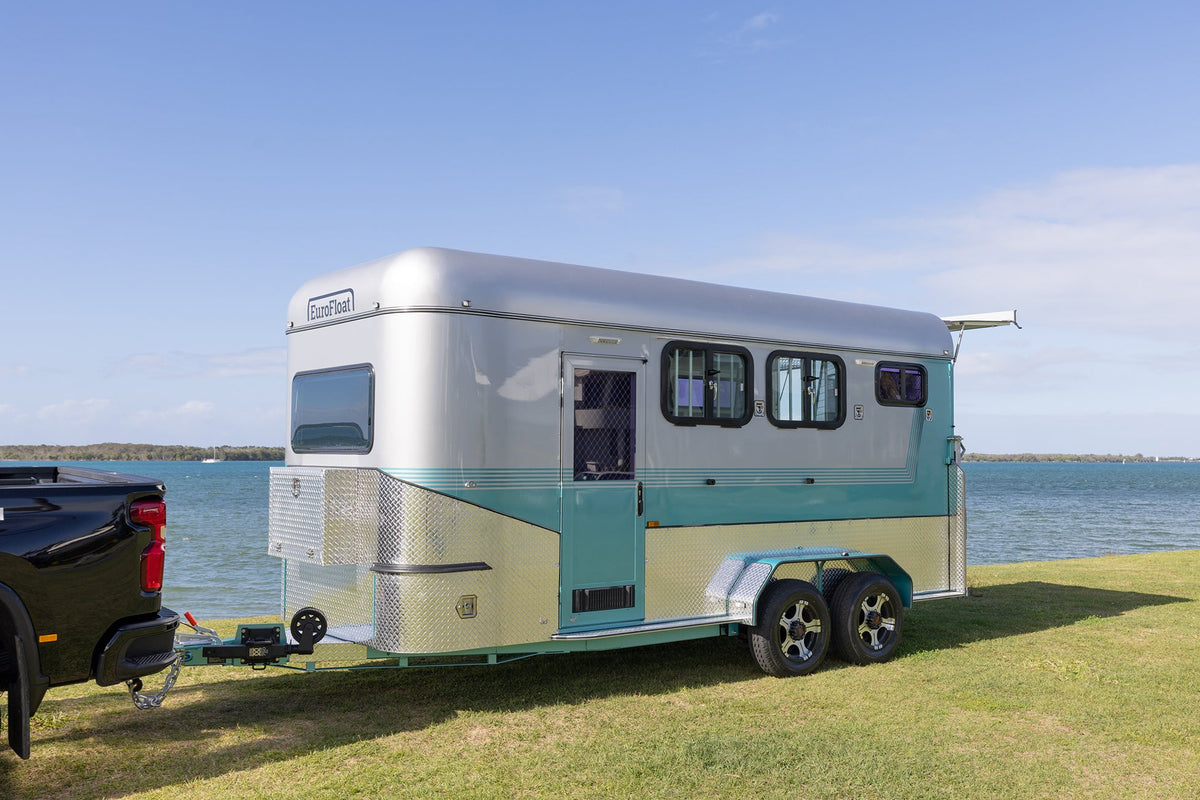
What can tow a horse float depends on the fully loaded float, the vehicle manufacturer's towing capacity, GVM, GCM and the ratings of the towbar and coupling. A vehicle advertised as capable of towing 3,500 kg isn't automatically suitable for every float with a 3,500 kg ATM. You also need enough vehicle payload for passengers, equipment and tow ball download. The lowest applicable rating limits what you can tow. Check the exact vehicle and float combination before buying, rather than relying on the vehicle's advertised towing figure alone.
In this guide9 sections
- What vehicles can tow a horse float?
- How do towing capacity, GVM and GCM work together?
- What does the lowest towing rating mean?
- How much towing capacity do different EuroFloat models need?
- What towbar and towball do you need for a horse float?
- How much tow ball weight should a horse float have?
- What towing speed limits apply around Australia?
- How do you choose the right towing vehicle before buying?
- Questions buyers ask
G'day, Wes here. One of the first questions I ask when someone is looking at a horse float is what they'll be towing it with. A big towing number on a vehicle advertisement doesn't tell me enough. We need to look at the whole setup, particularly once horses and gear are on board.
What vehicles can tow a horse float?
There's no single type of vehicle that suits every horse float. The answer depends on the weight of the float when loaded and what the vehicle manufacturer permits.
Some floats are lighter than others, but you still need to check the ratings before deciding whether your vehicle is suitable. A towbar fitted to the back of a vehicle doesn't automatically mean it's rated to tow a loaded horse float.
The first thing I'd do is find the vehicle's handbook or manufacturer specifications. Check the exact model and configuration rather than assuming every version has the same ratings.
You'll need to establish:
- Towing capacity. How much the vehicle is permitted to tow under the manufacturer's requirements.
- GVM. How much the towing vehicle itself can weigh when loaded.
- GCM. The manufacturer's maximum permitted combination mass.
- Towbar rating. The load the fitted towing equipment is designed to handle.
- Coupling rating. The rating of the hitch and ball connecting the float.
- Tow ball download. The weight the float places onto the towing vehicle.
- Tyre ratings. The tyres must be suitable for the loads they're carrying.
It's possible for one limit to be suitable while another isn't. That's why I always want the actual numbers before recommending a towing combination.
How do towing capacity, GVM and GCM work together?
These three terms are worth understanding because they affect different parts of the vehicle and float combination.
Towing capacity is the vehicle manufacturer's towing rating. GVM is the maximum permitted loaded mass of the towing vehicle.
GCM is the manufacturer's maximum permitted combination mass, which relates to the towing vehicle and the trailer load carried through its axles.
| Term | What it means | Why it matters |
|---|---|---|
| Towing capacity | Vehicle manufacturer's permitted towing load | Limits the trailer mass the vehicle can tow |
| GVM | Maximum permitted loaded vehicle mass | Includes vehicle occupants, luggage and coupling load |
| GCM | Manufacturer's maximum permitted combination mass | Limits the loaded vehicle and trailer combination |
| Towbar rating | Maximum permitted load for the towing equipment | May be lower than the vehicle's towing capacity |
| Tow ball download | Load transferred through the trailer coupling | Reduces available towing-vehicle payload |
Here's where people can get caught.
You might have a vehicle with a towing rating that appears suitable, but once you've added passengers, equipment and the load transferred from the float, you may run out of GVM or GCM allowance.
The vehicle's actual loaded weight matters, not just its empty weight.
I would never choose a float by towing capacity alone. You need all the relevant ratings to work together.
What does the lowest towing rating mean?
Transport for NSW says the loaded trailer must stay within the lowest applicable rating for the towbar and coupling, vehicle towing capacity, trailer capacity and tyres.
South Australia's driver's handbook also explains that you must not exceed the vehicle or towbar capacity, whichever is lower.
The principle is straightforward: one larger rating doesn't cancel out another smaller one.
For example, having a towbar rated above the vehicle's permitted towing capacity doesn't increase what that vehicle is allowed to tow.
I'd work through the limits in this order:
- Confirm the manufacturer's towing capacity.
- Check the fitted towbar and coupling ratings.
- Find the float's ATM and its actual loaded weight.
- Confirm the trailer tyres are suitable for their loads.
- Check the towing vehicle's loaded GVM and the combination's GCM.
- Confirm the hitch arrangement and applicable road rules.
You must stay within every relevant limit, not simply the largest number on the list.
Queensland's Department of Transport and Main Roads also explains that a trailer with an ATM higher than the vehicle's towing rating may be towable if its actual loaded mass remains within the vehicle's permitted rating.
That doesn't mean you should assume it's allowed everywhere or that it solves the other limits. Check the relevant state rules and the whole towing combination.
How much towing capacity do different EuroFloat models need?
The weight requirements change between models. A basic 2 horse straight load, a 2 horse angle load and an Overnighter aren't the same towing job.
Here are three examples from our range, using the maximum ATM as the planned loaded trailer mass. These ATM figures are as listed on our website.
| EuroFloat model | ATM | Vehicle towing rating for full ATM loading | Towbar and coupling requirement |
|---|---|---|---|
| 2 Horse Straight Load S RN Classic | 2,950 kg | At least 2,950 kg | Rated for at least 2,950 kg |
| 2 Horse Angle Load S SN | 3,500 kg | At least 3,500 kg | Rated for at least 3,500 kg |
| Mid Overnighter 2.1 | 3,800 kg | At least 3,800 kg | Rated for at least 3,800 kg |
These figures show the towing ratings needed if you intend to load each float to its full ATM. They aren't a complete vehicle suitability check.
You can't work out the required GVM or GCM from the float's ATM alone. You also need the actual loaded vehicle mass, trailer axle load and coupling download.
A 3,500 kg towing rating doesn't automatically mean a vehicle has enough available GCM or payload to tow a float loaded to 3,500 kg.
Before buying, I would have the full combination checked.
For an explanation of tare, ATM, GTM and how payload is calculated, read our horse float weight guide.
What towbar and towball do you need for a horse float?
The coupling has to be suitable for the trailer's rating and match the towing equipment on the vehicle.
For conventional ball couplings rated up to 3,500 kg ATM, the national vehicle standards include 50 mm ball couplings with appropriate ratings.
A 50 mm coupling is not automatically rated to 3,500 kg. Check the markings and approved capacity of the actual equipment.
For trailers over 3,500 kg ATM, different mechanical connection requirements apply under ADR 62.
At EuroFloat, our towing equipment guidance specifies a 70 mm hitch and ball for floats over 3,500 kg ATM. We also list a tow ball and tongue unit for $290.
That is our specified equipment arrangement, not a statement that every trailer over 3,500 kg must use a 70 mm ball.
Before hitching, confirm:
- The coupling and towball are compatible.
- The marked capacities suit the trailer.
- The towbar is rated for the intended load.
- The correct locking equipment is fitted.
- The connection is secure and operating properly.
- The installation meets the relevant requirements.
Don't fit a larger ball or different coupling and assume you've increased your vehicle's towing capacity.
The towing vehicle, hitch installation and float must all be suitable for the same job.
How much tow ball weight should a horse float have?
Tow ball download is the portion of the float's weight carried by the towing vehicle through the ball coupling.
It changes with the way the float is loaded, so a figure measured on an empty float may be different once horses and equipment are on board.
National trailer guidance uses ATM minus GTM to describe tow ball down-weight at the relevant maximum loading condition.
Transport for NSW and Western Australia's transport guidance refer to approximately 5–10% of the loaded trailer mass as a general guide.
That isn't a universal legal requirement to have exactly 10% tow ball download.
The correct loading must remain within the actual vehicle, towbar, coupling and trailer requirements.
Too much download can overload the towing vehicle or towbar. Too little may contribute to an unsuitable towing arrangement.
I'd rather have the actual coupling load checked than make assumptions from the number of horses travelling.
Keep heavy equipment properly positioned and follow the float manufacturer's loading guidance. The load transferred through the coupling also needs to be accounted for within the towing vehicle's GVM.
What towing speed limits apply around Australia?
Towing rules aren't identical in every state, so you need to know what applies along your route.
Two useful examples are New South Wales and Western Australia.
| State | Confirmed towing speed rule |
|---|---|
| NSW | Maximum 100 km/h when the towing vehicle's GVM exceeds 4.5 tonnes or the combination's GCM exceeds 4.5 tonnes |
| WA | Maximum 100 km/h when towing, or the posted limit if lower |
| QLD | The published towing guidance does not impose a separate general towing speed limit |
| SA | Follow the speed limit applying to the road |
| VIC, TAS, NT and ACT | Check with the relevant state or territory transport authority |
These rules don't override lower posted limits, licence conditions or the need to drive appropriately for the conditions.
In NSW, pay particular attention to the GCM figure. A vehicle may be subject to the 100 km/h towing rule because of its rated combination mass.
Other road and licence conditions can also apply, especially for learner and provisional drivers.
Read our P-plate towing guide if you're checking what a younger driver can tow.
How do you choose the right towing vehicle before buying?
I'd start with the horses and the float, then work out which vehicles are suitable.
Think about your normal travelling weight, not just the empty float. Include the horses, tack, feed, water and other equipment.
Then check the manufacturer's vehicle ratings and confirm the appropriate hitch arrangement.
A practical checklist is:
- Decide how many horses you'll regularly carry.
- Identify the float models and their loading limits.
- Work out the expected actual loaded trailer weight.
- Check the vehicle's permitted towing capacity.
- Check the vehicle's GVM and GCM.
- Allow for passengers, equipment and coupling download.
- Confirm the towbar, coupling and tyre ratings.
- Check any licence and state-specific requirements.
- Get qualified advice if the ratings or installation are unclear.
At EuroFloat, you can arrange a test tow behind your own suitable vehicle at our Gold Coast or Melbourne showroom.
I want buyers to understand what their vehicle can carry before committing to a float. It's much easier to choose the right setup at the start than discover a problem after purchase.
"These floats are well made and have everything you need. Tows well and is easy to hitch on your vehicle."
Nicholle Mallitt, Google review ★★★★★
Questions buyers ask
Can any car with a towbar tow a horse float?
No. The vehicle, towbar, coupling and tyres must have suitable ratings, and the loaded combination must remain within the applicable limits.
Is a 3,500 kg towing capacity enough for a 3,500 kg ATM float?
Not automatically. You also need adequate GVM, GCM, coupling download allowance and correctly rated towing equipment.
What is GCM when towing a horse float?
GCM is the manufacturer's maximum permitted combination mass. It needs to be checked against the actual loaded vehicle and trailer arrangement.
Is 10% tow ball weight a legal requirement?
Official guidance doesn't set a universal legal 10% rule. NSW and WA give approximately 5–10% as general guidance, subject to the actual ratings.
Can you tow a float rated above your vehicle's towing capacity?
Queensland guidance allows for some situations where the trailer's ATM exceeds the vehicle rating but its actual loaded weight does not. Check your state authority and every other applicable vehicle and trailer limit.
Can I test tow a EuroFloat before buying?
Yes. Test towing behind your own suitable vehicle is available by appointment at EuroFloat's Gold Coast and Melbourne showrooms.
Match your vehicle to the right float
Compare EuroFloat models and check the towing requirements before choosing the float that suits your horses.


Towing information is general guidance. Check the actual float's compliance plate, vehicle manufacturer's ratings, equipment specifications and applicable state rules before travelling.
