

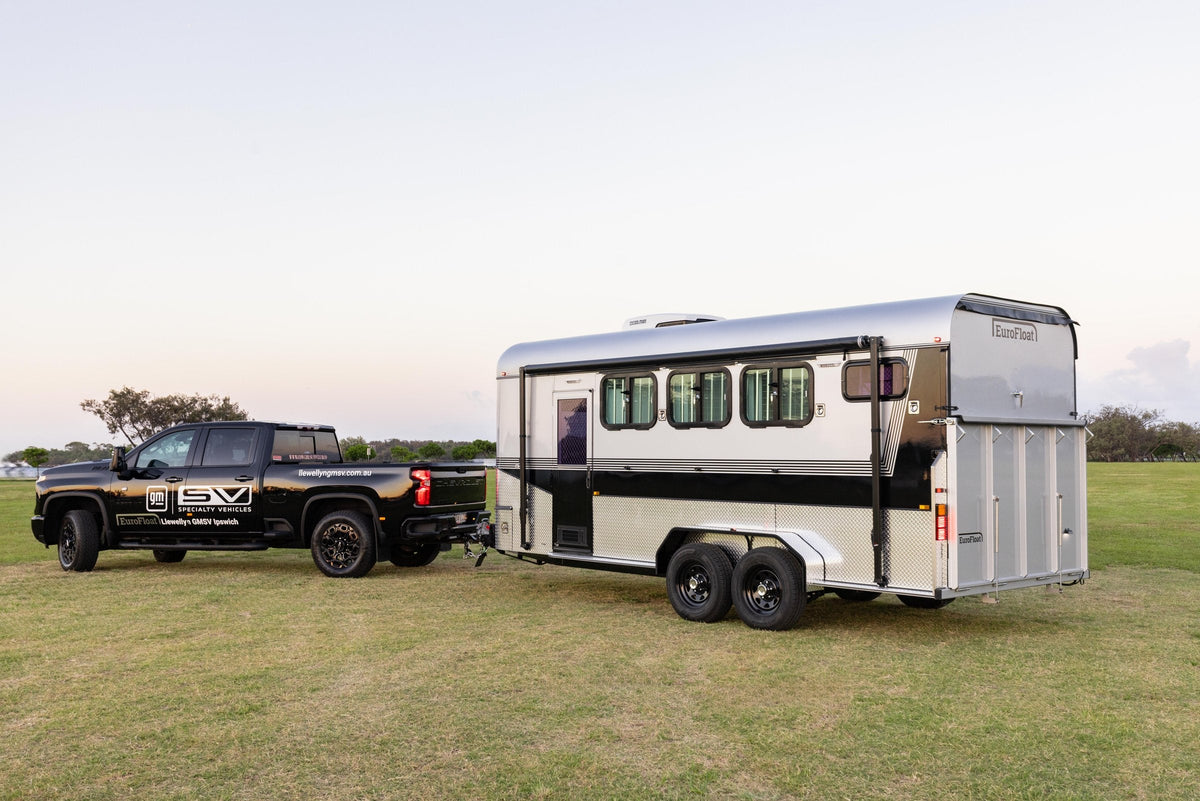
Safe horse float towing starts before you turn the key. Check your vehicle can tow the loaded float, stay under your ATM and GCM, and run the same pre-tow checklist every trip: coupling, chains, plug, breakaway cable, lights, brakes, tyres and doors. Load the heavier horse on the right, drive smoothly, and stop every few hours to check your horses. A float that tows straight and stable makes all of this easier, and that's what our customers say about their EuroFloats.
In this guide9 sections
G'day, Wes here. Whether you've just bought your first horse float or you've been towing for years, a good routine is what keeps you and your horses safe. This is the checklist I'd want every EuroFloat owner to run before they pull out of the driveway. Print it, stick it in the tack room, and use it every time.
Why how a float tows matters
Your horses can't brace for a corner or see a stop coming. They balance through every brake, turn and bump. A horse float that tracks straight and sits steady behind your vehicle means a calmer horse and a less tiring drive for you.
A float that wanders, bounces or pushes the back of your vehicle around does the opposite. That's why, when you're comparing horse floats for sale, how the float tows should be near the top of your list, right up there with bay size and price.
Know your weights first
Before anything else, make sure your vehicle can legally and safely tow the float with your horses on board.
- ATM (Aggregate Trailer Mass): the most the float can weigh fully loaded. It's on the compliance plate and every EuroFloat model page.
- GCM (Gross Combination Mass): the most your vehicle and loaded float can weigh together, including passengers, fuel and gear. It's in your vehicle's handbook.
- Towing capacity: the most your vehicle can tow.
- Tow ball limit: the most weight your towbar can carry.
Stay under all four, every trip. Towing over them is illegal, unsafe, and can give your insurer grounds to refuse a claim. Not sure where you stand? Send me your vehicle's make, model and year and we'll check it against the float. Read Horse float insurance for more on why this matters.
The pre-tow checklist
Do these in the same order every time. Routine is what stops you missing something when you're running late for a show.


Your vehicle
- Tyre pressures set for towing (check your vehicle's handbook)
- Towing mirrors fitted if the float is wider than your vehicle
- Electric brake controller working and set for the load
- Fuel up before you hook on, so you're not squeezing into a servo with a float
Your float
- Float tyres: pressure, tread, cracks and age
- Wheel nuts tight
- Floor solid, with no soft spots
- Ramp, storm door, side doors and windows close and latch properly
- Dividers locked in position
- Tack, feed and gear stowed and tied down, fridge and cupboards shut
- Service up to date (at least every 12 months)
Coupling and connections
- Coupling seated on the ball, closed and locked, with the safety pin in
- Safety chains attached with rated shackles, crossed under the coupling
- Trailer plug connected
- Breakaway cable attached to the vehicle, not the chains
- Jockey wheel wound all the way up and secured
Final walk-around
- Lights tested with a helper: tail, brake and both indicators
- Brakes tested at walking pace before you load horses
- Horses loaded, tied with quick-release knots, and ramp up and latched
- One last lap of the vehicle and float before you drive off
Loading for a balanced float
- One horse in a straight load? Put them on the right, the driver's side. Australian roads are cambered towards the left edge, so this helps the float sit level.
- Two horses of different sizes? Heavier horse on the right.
- Heavy gear goes low and over the axles, not hanging off the back.
- Watch your ball weight. Too little and the float can get light and unstable. Too much and it overloads your towbar and lifts your front wheels. Around 10% of the loaded float's weight is a common guide, but always stay within your vehicle's tow ball limit.
- Water tanks: full tanks add a lot of weight. Count them in your ATM.
On the road
- Drive for your horses. Gentle on the accelerator, brake early and smoothly, and take corners slower and wider.
- Leave a big gap. You'll need much more distance to stop with a loaded horse float.
- Stop after the first few kilometres and re-check the coupling, chains, plug and doors.
- Plan breaks. Stop every few hours to check your horses, offer water and rest yourself.
- Watch the conditions. Slow down for wind, rain, gravel and rough roads, and use a lower gear on long descents rather than riding the brakes.
- Know the rules. Towing speed limits, mirror rules and licence rules vary by state. Check with your state's road authority before a long trip.
If the float starts to sway
- Ease off the accelerator. Don't slam on the vehicle's brakes.
- Hold the steering wheel straight. Don't try to steer out of it.
- Gently apply the float's brakes with the manual lever on your brake controller. This helps pull the float back in line.
- Once it's settled, pull over safely and work out why. Check your load, ball weight, tyre pressures and speed before you carry on.
Prevention is the real answer: the right ball weight, the right tyre pressures, sensible speed and a well-built float.
Arriving and unloading

- Park on level ground with room to lower the ramp and walk your horses off safely.
- Chock the float's wheels before you unhitch.
- Unload horses before you unhook the float. Never unhitch with horses on board.
- Give the float a quick look over: tyres, wheels, lights and any damage from the trip.
Why EuroFloats tow the best

I'll be upfront: I'm biased. But you don't have to take my word for it. Our customers' reviews say EuroFloats tow better than anything else on the market, and how a float feels on the road is the thing they mention most.
"It towed perfectly straight it was rock solid on the road."
Michael Davidson, Google review ★★★★★
"Tows well and is easy to hitch on your vehicle."
Nicholle Mallitt, Google review ★★★★★
Here's what goes into that:
- Running gear installed and inspected for Australian roads. Corrugations, gravel and long highway runs included.
- A breakaway safety unit on every float. If the float ever comes off your vehicle, it applies the float's brakes.
- Braking and lighting set up for road safety and visibility, with electrical work done by qualified tradespeople.
- Prestige models step it up with a reinforced chassis, Japanese bearings and 316 marine-grade stainless hardware.
The best way to judge how a horse float tows is to tow it. Book a test drive at our Gold Coast or Melbourne showroom and take a EuroFloat out behind your own vehicle. EuroFloat is Australian owned and operated, so you'll deal with our own team from your first test drive to handover and every service after.
Looking at horse floats for sale? Every 2-horse straight load, 2-horse angle load, 3-horse angle load and Overnighter in our range is built to tow the same way. See what's in stock now.
Questions buyers ask
Which side should a single horse travel on?
In a straight load float, put a single horse, or the heavier of two, on the right-hand side. Australian roads slope towards the left edge, so this helps the float sit level.
How often should I stop on a long trip?
Every few hours. Check your horses, offer water, re-check the coupling and give yourself a break too.
Do I need an electric brake controller?
Most horse floats are heavy enough to need brakes you can control from the driver's seat, which means an electric brake controller in your vehicle. We'll confirm what your vehicle needs when we check it against your float.
What should I do if my float sways?
Ease off the accelerator, hold the wheel straight and gently apply the float's brakes with the brake controller's manual lever. Don't brake hard in the vehicle or swerve.
Can I test tow a EuroFloat before I buy?
Yes. Book a test drive at our Gold Coast or Melbourne showroom and tow a float behind your own vehicle.
Is EuroFloat an Australian company?
Yes. EuroFloat is Australian owned and operated, with showrooms on the Gold Coast and in Melbourne.
Feel the difference behind your own vehicle
Book a test drive at our Gold Coast or Melbourne showroom. We'll check your vehicle's ATM and GCM against the float before you go.


This guide is general information. Always follow your vehicle maker's limits, your float's ATM and your state's towing and animal welfare rules. Reviews from EuroFloat's Google reviews.
