

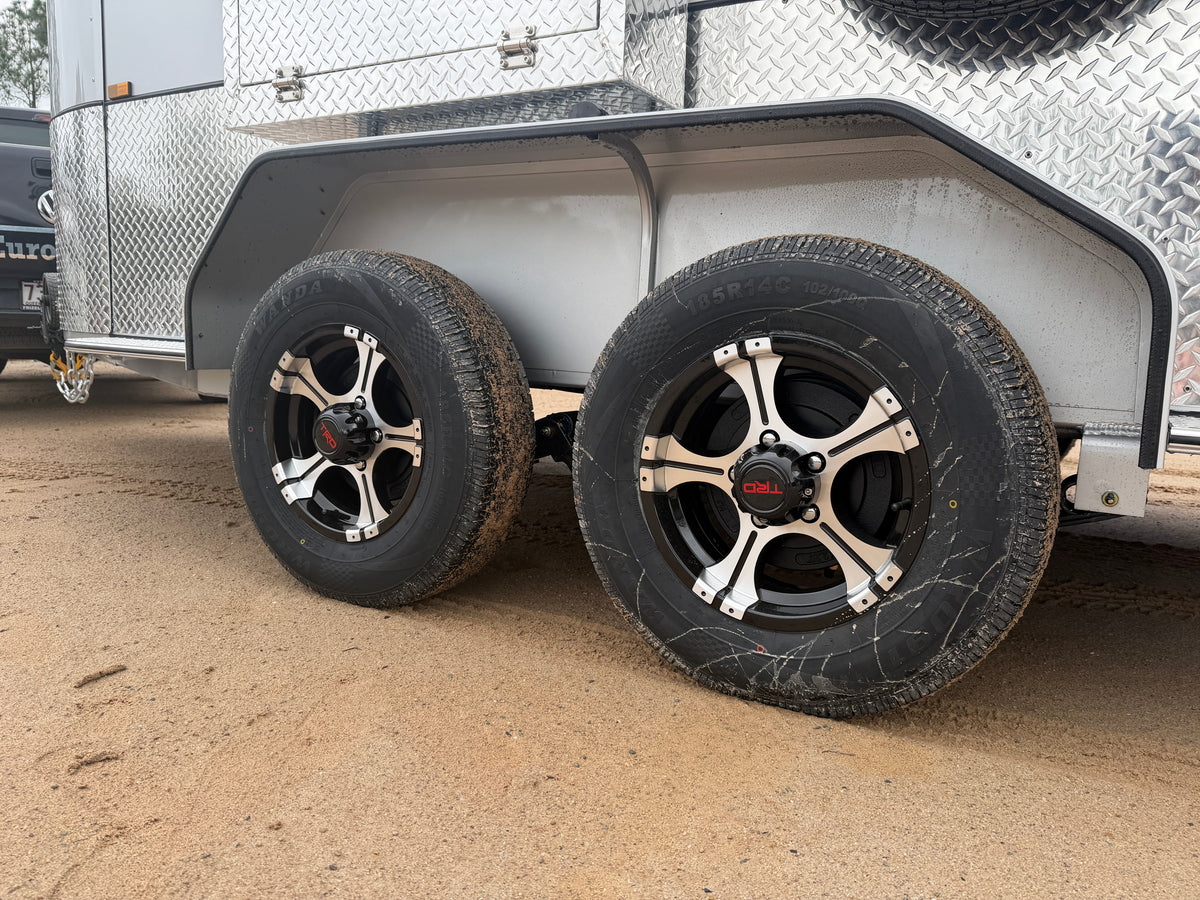
Horse float suspension helps support the float's load and allows the wheels and axles to respond to bumps and uneven roads. Common arrangements include leaf springs, roller-rocker suspension, torsion or rubber suspension and independent systems. They work differently, and no suspension type should be judged without considering the whole float, its weight and maintenance. For owners, the important checks include springs, shackles, bushes, U-bolts, ride height, tyre wear and bearings. A properly maintained system matters for safe towing and the horses travelling inside.
In this guide10 sections
- What does horse float suspension actually do?
- What are the different types of horse float suspension?
- How does roller-rocker suspension work?
- What suspension and running gear does EuroFloat use?
- Does suspension change how a horse float feels on the road?
- What suspension parts should you check regularly?
- What are the warning signs of worn suspension?
- How often should horse float suspension be serviced?
- What should you ask about suspension when buying a float?
- Questions buyers ask
G'day, Wes here. Suspension isn't usually the first thing someone asks about when they're buying a horse float. They want to know the price, how many horses it carries and what it looks like inside. But what's underneath the float matters too, particularly when you're towing regularly on different roads.
What does horse float suspension actually do?
Suspension connects the float's body and chassis to the wheel and axle arrangement. Its job is to help support the load while allowing movement as the wheels travel over the road.
Without that movement, bumps and uneven surfaces would be transferred much more directly through the float.
There are different ways to achieve this, and each system has its own components and maintenance requirements.
When you're towing horses, I think it's important to look at the whole setup rather than one suspension feature.
The springs, axles, tyres, bearings, brakes and weight distribution all work together as part of the travelling combination.
A float with a particular suspension type isn't automatically going to ride smoothly in every situation.
The horse load, tyre condition, road surface, towing vehicle and driving also affect how the float behaves.
That's why I would start with these questions:
- What suspension system is fitted?
- What load is it designed to carry?
- How are the axles arranged?
- What components need servicing?
- How can wear or damage be identified?
- Does the manufacturer provide clear maintenance instructions?
You don't need to become a mechanic to own a horse float. But you should understand enough to recognise when something needs attention.
What are the different types of horse float suspension?
There are several suspension arrangements used on trailers, including horse floats.
The names can sound complicated, but the main differences come down to how the system supports the load and allows movement.
Here's a general comparison.
| Suspension type | How it works | What to consider |
|---|---|---|
| Leaf spring | Stacked or formed spring leaves bend under load | Springs, shackles, bushes and mounting points |
| Roller-rocker | Leaf springs work with a rocker arrangement on tandem axles | Spring condition, rocker movement and load sharing |
| Torsion or rubber | Rubber elements or a torsion arrangement provide resistance to wheel movement | Manufacturer-specific wear, ratings and service instructions |
| Independent | Wheel assemblies can move independently through their designed suspension mechanisms | Joints, mounts, alignment and component condition |
These are broad descriptions. The exact design varies between products.
A roller-rocker system is part of the leaf-spring family. It isn't the same thing as every ordinary leaf-spring arrangement.
Independent suspension is a different description of how the wheel movement is arranged. It doesn't automatically tell you everything about the springing or damping system.
Likewise, rubber or torsion suspension isn't one single design used in exactly the same way on every trailer.
I'd always ask for the specific system fitted to the float rather than relying on a general label.
How does roller-rocker suspension work?
Roller-rocker suspension is commonly associated with tandem-axle trailer arrangements.
It uses leaf springs along with a rocker mechanism between the axle positions.
As the wheels travel over uneven ground, the springs and rocker allow movement and help share the load between the axles.
That doesn't mean every axle always carries exactly the same weight. The actual loading and road conditions still matter.
The rocker arrangement needs to be in good condition so the components can move as intended.
Parts worth knowing about include:
- Leaf springs. Support the load and allow movement through the spring arrangement.
- Rocker mechanism. Connects the suspension movement between axle positions.
- Shackles. Allow the spring connections to move through their intended range.
- Bushes. Sit within relevant pivot points and can wear over time.
- U-bolts. Secure axle assemblies in their designed positions.
- Mounting points. Connect the suspension equipment to the trailer.
These components are exposed to regular movement while the float is travelling.
Wear doesn't always announce itself with an obvious failure. Sometimes it shows up as unusual movement, noise or changes in how the float sits.
That's why regular inspection matters.
If something looks loose, damaged or out of position, have it assessed before towing again.
What suspension and running gear does EuroFloat use?
Our specification sheets for the 2 horse angle load, 3 horse angle load and Overnighter ranges list twin axles rated at 2,000 kg each.
Those sheets also list 8-plate roller-rocker springs and 4-wheel electric brakes with breakaway.
The brakes are a separate part of the running gear, but it's useful to understand the complete arrangement when comparing floats.
Here's the specification-sheet summary.
| EuroFloat range | Listed axle arrangement | Listed suspension | Listed braking |
|---|---|---|---|
| 2 horse angle loads | Twin 2,000 kg-rated axles | 8-plate roller-rocker springs | 4-wheel electric brakes with breakaway |
| 3 horse angle loads | Twin 2,000 kg-rated axles | 8-plate roller-rocker springs | 4-wheel electric brakes with breakaway |
| Overnighters | Twin 2,000 kg-rated axles | 8-plate roller-rocker springs | 4-wheel electric brakes with breakaway |
These are the configurations described in our specification sheets.
For straight loads, check the actual model's running-gear information rather than assuming it uses the same arrangement.
Our Prestige product pages also list 6-stud axles with 15-inch wheels on angle loads and 5-stud axles with 14-inch wheels on straight loads.
The Prestige series includes Japanese bearings.
Bearings are part of the wheel and hub assembly rather than the suspension itself, but they still need checking as part of normal running-gear maintenance.
When you're comparing floats, I'd look at the suspension, brakes, axles and wheels together rather than treating each feature as a separate selling point.
Does suspension change how a horse float feels on the road?
It can, but suspension is only one part of the way a float behaves.
As a float travels, the wheels respond to changes in the road surface. The suspension allows movement while supporting the load.
Different systems can respond differently to bumps, uneven ground and changes in loading.
However, I wouldn't tell you that one type automatically gives every float a smoother ride.
The complete combination matters.
Think about:
- Loaded weight. A float carries different loads depending on the horses and equipment.
- Weight distribution. Where the load sits affects the towing combination.
- Tyres. Type, condition, pressure and load rating all matter.
- Suspension condition. Worn components may affect how the system operates.
- Axle arrangement. The complete running gear needs to suit the float.
- Road conditions. Smooth highways and uneven tracks place different demands on equipment.
- Driving. Speed, braking and cornering affect how the horses experience the journey.
Horses have to balance as the float moves. That's one reason I always encourage smooth, careful driving.
Good suspension maintenance supports the system doing its intended job, but it doesn't replace correct loading or sensible towing.
For the routine I recommend before setting off, read safe horse float towing.
What suspension parts should you check regularly?
The first thing is to know what system your float actually has.
A roller-rocker system has different inspection points from some torsion arrangements, so use the manufacturer's servicing instructions.
For a leaf-spring or roller-rocker arrangement, I'd want a qualified mechanic checking the following areas.
- Springs. Look for damage, cracks, deformation or other abnormal condition.
- Shackles. Check for wear, damage and movement outside the intended range.
- Bushes. Worn bushes can affect the operation of the spring connections.
- U-bolts. Check condition and correct fastening using the specified procedures.
- Rockers. Confirm the mechanism moves and sits as intended.
- Mounting points. Look for looseness, damage or movement.
- Axles. Check for damage, alignment concerns and abnormal wear.
- Bearings. Include wheel and hub inspection in the service.
- Tyres. Look for unusual wear that could indicate another problem.
Don't attempt to tighten important suspension fasteners to a guessed setting.
These components can carry significant loads. Work underneath a float must be done with suitable equipment and safe support.
For owners, a visual check may be enough to recognise that something looks wrong. The repair or technical assessment should be left to someone properly qualified.
Our horse float servicing guide covers the wider maintenance checks.
What are the warning signs of worn suspension?
You don't always need to identify the exact failed part to know a float needs attention.
Sometimes the first clue is a change in how the float sits, sounds or travels.
A tyre wearing differently from the others can also be a sign worth investigating.
Some warning signs include:
- Uneven or sagging ride height when the float is appropriately parked.
- Visible damage to springs, shackles or mounting points.
- Unusual noises from the running gear.
- Movement or looseness in components that should be secured.
- Tyres wearing unevenly or unusually quickly.
- Damage around suspension connections.
- A noticeable change in towing behaviour.
These symptoms don't all prove the suspension is at fault. Tyres, bearings, loading and other components can cause similar problems.
The important thing is not to ignore the change.
If the float starts behaving differently on the road, stop safely and have it checked before continuing if there's a concern about its condition.
Don't try to compensate for a mechanical problem simply by changing how you load the float.
And don't keep using equipment that appears damaged because the next service is still some time away.
Our horse float tyre guide explains what to look for in the tyres and why their condition matters.
How often should horse float suspension be serviced?
There isn't one servicing routine that suits every suspension design and every type of use.
Follow the float manufacturer's schedule and the recommendations for its fitted components.
For EuroFloat, the warranty conditions require servicing at least every 12 months by a qualified mechanic, with the records kept.
Every new EuroFloat has a 2-Year Warranty covering the suspension along with the other specified components. It starts on the day you pick up your float.
Keeping the servicing records is part of maintaining that warranty.
Regular checks between services still matter, particularly if you're travelling frequently or notice something unusual.
I'd keep a record of:
- The date of each service.
- Who carried out the work.
- Any suspension or running-gear parts inspected.
- Repairs or replacements completed.
- Tyre and bearing issues identified.
- Any recommendations for further attention.
That information is useful when you're planning maintenance and when you're selling the float later.
It also helps a mechanic understand what has already been checked.
At EuroFloat, our Service Centre handles servicing, repairs, warranty and parts.
I'd rather have an unusual noise or worn component checked early than wait until it causes a problem on a trip.
What should you ask about suspension when buying a float?
When you're choosing a new or second-hand float, don't stop at the statement that it has a particular suspension type.
Ask what is actually fitted and whether the arrangement suits the float's intended load.
For a second-hand float, maintenance history becomes particularly important.
Here's what I'd ask the seller:
- What suspension system is fitted?
- What are the axle and trailer ratings?
- When was the suspension last inspected?
- Are there servicing records?
- Have springs, bushes or shackles been replaced?
- Have there been any axle or bearing repairs?
- Is there unusual tyre wear?
- Has the suspension been modified?
- Can a qualified mechanic inspect the running gear before purchase?
If the seller can't explain the equipment, ask for the manufacturer's documentation.
Don't assume that a recently painted underside means everything is in good condition.
If you're looking at a new float, have the running gear explained alongside the tare, ATM and permitted load.
It's easier to look after equipment when you know how it's meant to work.
Suspension isn't usually the feature people get excited about at a showroom, but it deserves the same attention as the horse bays and living equipment.
Questions buyers ask
What type of suspension do horse floats have?
Different horse floats use leaf-spring, roller-rocker, torsion or independent arrangements. The correct description depends on the particular model and its running gear.
What is roller-rocker suspension on a horse float?
It's a leaf-spring arrangement commonly used on tandem-axle trailers. A rocker mechanism allows movement between the axle positions and helps share the load.
Is independent suspension better for a horse float?
Not automatically. The whole trailer design, load, component ratings, maintenance and towing conditions matter. Compare the actual equipment rather than relying on the suspension name.
What suspension does EuroFloat use?
Our specification sheets for 2 horse angle loads, 3 horse angle loads and Overnighters list 8-plate roller-rocker springs with twin axles rated at 2,000 kg each. Check the particular model's specification.
How often should EuroFloat suspension be serviced?
EuroFloat's warranty conditions require servicing at least every 12 months by a qualified mechanic. Keep the records and arrange additional checks whenever something appears wrong.
Is EuroFloat suspension covered by warranty?
Yes. Suspension is included in the 2-Year Warranty on every new EuroFloat, starting when you pick up the float. Conditions apply.
Look beyond the horse bays
Compare the complete EuroFloat range and ask us about the running gear, maintenance and warranty for the model you're considering.


Suspension information is general guidance. Check the actual float's specifications, follow manufacturer servicing instructions and have running-gear concerns assessed by a qualified mechanic. Warranty conditions apply.
