

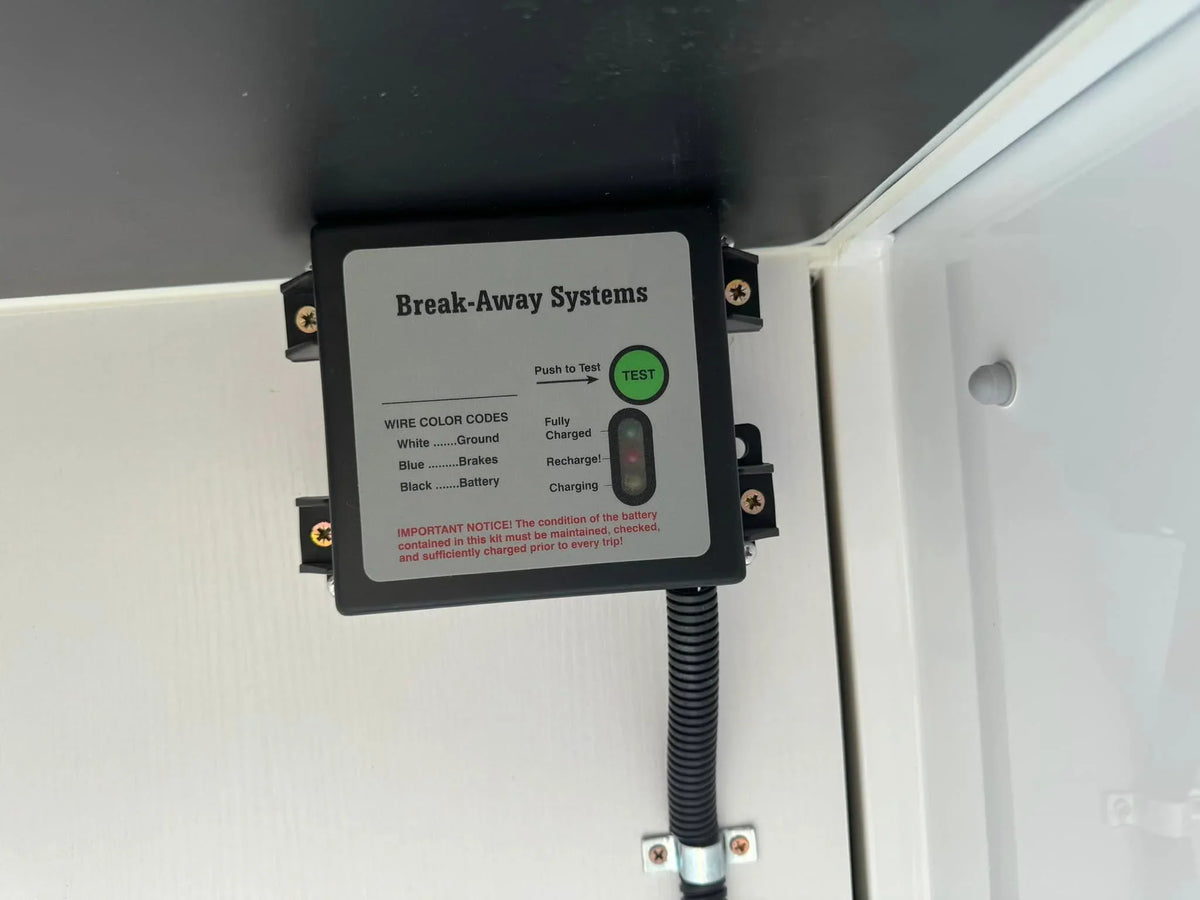
Horse float brakes are required according to the trailer's GTM, not its ATM. Under Australia's national trailer standards, brakes are required above 750 kg GTM. Above 2,000 kg GTM, brakes must operate on all wheels, be controlled from the towing vehicle and include a breakaway system that keeps the brakes applied for at least 15 minutes following separation. A brake controller operates compatible electric trailer brakes from the towing vehicle. Every EuroFloat has a breakaway safety unit, but the exact braking equipment should be checked for the model you're towing.
In this guide9 sections
- When does a horse float need brakes in Australia?
- What's the difference between electric brakes and override brakes?
- What does an electric brake controller do?
- How does a horse float breakaway system work?
- What safety chains does a horse float need?
- What brakes and breakaway equipment does EuroFloat use?
- What should you check before towing?
- How are horse float brakes serviced?
- Questions buyers ask
G'day, Wes here. Brakes are one of the things I want people to understand before they start towing horses. It's not enough to know your vehicle can pull the float. You need the trailer braking system to be suitable for the load and working properly every time you leave.
When does a horse float need brakes in Australia?
Australian trailer brake requirements depend on GTM, which stands for Gross Trailer Mass.
That's the mass supported by the trailer's wheels when it's coupled and loaded. It doesn't include the portion of the trailer's weight carried by the towing vehicle through the coupling.
ATM is different. It includes the trailer's total loaded mass, including the coupling load.
The national rules in Vehicle Standards Bulletin 1 and ADR 38/05 use GTM to determine the trailer braking requirements.
Here's the general breakdown for light trailers.
| Trailer GTM | Required braking arrangement |
|---|---|
| Up to 750 kg | Brakes aren't required under the general rule |
| Over 750 kg to 2,000 kg | Service brakes required; an axle-only arrangement may be permitted |
| Over 2,000 kg | Brakes required on all wheels, controlled from the towing vehicle, with a compliant breakaway system |
These requirements apply within the relevant national light-trailer standards. The exact equipment must comply with the rules applicable to the trailer.
For trailers over 2,000 kg GTM, the required braking arrangement cannot rely on ordinary over-run or override brakes.
The most important point is not to work out the braking requirements from ATM alone.
EuroFloat's model range has listed ATM figures starting at 2,950 kg, but ATM by itself doesn't establish the actual GTM or every detail of the required braking arrangement.
Always check the rated and fitted equipment on the actual float.
What's the difference between electric brakes and override brakes?
Electric trailer brakes use a control signal from the towing vehicle to operate the braking system.
A compatible brake controller in the towing vehicle manages the signal delivered to the trailer brakes.
Override brakes work differently. They respond mechanically or hydraulically to the trailer pushing against the coupling as the towing vehicle slows.
Australian standards permit certain over-run braking arrangements on trailers with a GTM of up to 2,000 kg, subject to the applicable requirements.
Above 2,000 kg GTM, the national rules require braking on all wheels with control from the towing vehicle.
| Brake type | How it generally works | Important consideration |
|---|---|---|
| Electric | Brakes respond to a compatible electrical control signal | Needs suitable controller, wiring and adjustment |
| Override or over-run | Coupling movement operates the braking mechanism | Not permitted as the braking arrangement above 2,000 kg GTM |
| Breakaway | Activates required trailer braking after a qualifying separation | Must operate independently as required by the applicable standard |
The type of brakes fitted needs to match the trailer's requirements.
I wouldn't make assumptions because two floats have similar axles or look alike underneath.
Ask what system is actually fitted, how it operates and what the towing vehicle needs to run it correctly.
What does an electric brake controller do?
An electric brake controller lets the towing vehicle operate compatible electric brakes on the float.
Depending on the controller, the system responds to braking and allows the driver to adjust how strongly the trailer brakes are applied.
That adjustment is often called gain.
The appropriate gain can change with the load, because a float carrying horses and equipment is different from the same float travelling empty.
I would always have the controller installed and set up properly for the particular vehicle and trailer combination.
Here's what matters:
- Compatibility. The controller must suit the fitted braking system.
- Installation. Wiring and connections need to be completed correctly.
- Gain. Set braking response according to the controller manufacturer's instructions.
- Function. Confirm the brakes respond as expected.
- Load. Consider the actual loaded trailer when setting the system.
- Faults. Investigate warnings or inconsistent braking before travelling.
Don't simply wind the controller up as high as it will go.
Too much braking effort can cause problems, just as too little can leave the trailer braking inadequately.
Follow the controller's instructions and arrange professional assistance if you're not confident with the setup.
EuroFloat can quote a suitable brake controller when you're discussing your towing arrangement.
How does a horse float breakaway system work?
A breakaway system is designed to activate the trailer brakes if the trailer separates from the towing vehicle.
It's an emergency arrangement, not something intended to replace normal trailer braking.
Under the national standards, trailers above 2,000 kg GTM require a breakaway braking system that keeps the brakes applied for at least 15 minutes following a qualifying separation.
Every EuroFloat has a breakaway safety unit.
Our specification sheets for the 2 horse angle load, 3 horse angle load and Overnighter ranges also list 4-wheel electric brakes with breakaway.
The important thing is that the breakaway system needs to be in working order, including its power supply and the equipment that activates it.
A system that looks complete from outside may still have a flat battery or another fault.
Before travelling:
- Check the breakaway battery's charge and condition.
- Inspect the cable and connections for damage.
- Attach the breakaway cable to the appropriate point on the towing vehicle.
- Don't attach the breakaway cable to the safety chains.
- Follow the manufacturer's required test procedure.
- Investigate any failed test before using the float.
Don't deliberately disconnect a trailer to test the system.
The breakaway test should be done using the approved procedure for the fitted equipment, with the float safely secured.
What safety chains does a horse float need?
Safety chains provide an additional connection between a conventional rigid-drawbar trailer and the towing vehicle.
They're separate from the breakaway cable and need to be correctly rated and attached.
The national trailer standards set chain requirements using ATM rather than GTM.
| Trailer ATM | General safety chain requirement |
|---|---|
| Up to 2,500 kg | At least one compliant chain where chains are required |
| Over 2,500 kg to 3,500 kg | Two chains meeting AS 4177.4 |
| Over 3,500 kg | Two Grade T chains meeting the applicable requirements |
For the over-3,500 kg band, each Grade T chain must have a breaking load exceeding the trailer's ATM.
Rigid-drawbar trailers require safety chains even when they have breakaway brakes.
Transport for NSW advises crossing two chains beneath a conventional trailer's coupling, keeping them as short as practicable and connecting them to the towing vehicle.
Queensland's towing equipment guidance allows shackles that meet AS 2741 and says not to use padlocks to connect the chains.
Make sure the chains are attached to the intended rated points and have sufficient movement for turning without dragging along the road.
Gooseneck arrangements need to be checked against their own approved connection requirements rather than assuming ordinary towbar instructions apply.
The chains and breakaway cable perform different jobs, so don't treat one as a substitute for the other.
What brakes and breakaway equipment does EuroFloat use?
Every EuroFloat has a breakaway safety unit, and our range includes different float types and towing requirements.
Our specification sheets describe 4-wheel electric brakes with breakaway on the 2 horse angle loads, 3 horse angle loads and Overnighters.
The specification sheets for those ranges also list twin axles rated at 2,000 kg each.
That's a summary of the listed equipment, not a reason to assume the same configuration applies to every model.
| EuroFloat range | Braking information |
|---|---|
| 2 horse angle loads | Spec sheets list 4-wheel electric brakes with breakaway |
| 3 horse angle loads | Spec sheets list 4-wheel electric brakes with breakaway |
| Overnighters | Spec sheets list 4-wheel electric brakes with breakaway |
| Straight loads | Confirm the braking specification for the individual model |
| Every EuroFloat | Breakaway safety unit fitted |
Don't assume a particular controller, brake assembly or wiring arrangement is included unless it's confirmed for the model you're choosing.
I'd also ask about the brake controller requirements for your towing vehicle before arranging a test tow.
The vehicle and float need to operate together properly, and the actual combination has to remain within its weight limits.
You can compare the EuroFloat range and ask about the braking equipment on the model that interests you.
What should you check before towing?
Brakes should be part of every pre-tow routine.
You don't need to dismantle the equipment before each trip, but you do need to check that the system appears sound and works as intended.
Start with the visible connections, then carry out the appropriate functional checks.
Here's my routine:
- Brake controller. Confirm it's operating without a fault warning.
- Trailer plug. Make sure it's connected properly and undamaged.
- Brake response. Test the system at low speed in a suitable safe area, following the manufacturer's instructions.
- Breakaway battery. Confirm it's charged and passes its specified checks.
- Breakaway cable. Attach it correctly to the towing vehicle, separately from the chains.
- Safety chains. Confirm the correct chains and fittings are securely attached.
- Lights. Test brake lights and other required lighting.
- Wheels. Look for obvious damage or signs of a brake problem.
- Loading. Check the trailer's actual weight and towing limits.
If the brakes don't respond as expected, stop and find out why.
Don't continue with horses on board because the journey is short or the towing vehicle has powerful brakes.
Read Wes's pre-tow checklist for the complete routine.
How are horse float brakes serviced?
Brake components wear with use, and electrical connections and breakaway equipment also need attention over time.
A qualified mechanic should inspect the braking system according to the float and component manufacturers' instructions.
For electric brakes, that may include checking the brake components, magnets, wiring, connections and adjustment.
Breakaway equipment also needs its battery and operating condition checked.
I'd want the service record to show what was inspected and whether anything needed repairing.
Don't wait until the next service if you notice poor braking, unusual wheel heat, electrical faults or inconsistent controller behaviour.
EuroFloat requires servicing at least every 12 months by a qualified mechanic, with records kept, to maintain its 2-Year Warranty.
Our Service Centre handles servicing, repairs, warranty and parts.
For the wider maintenance schedule, read our horse float servicing guide.
The way I see it, brake maintenance is something you plan for throughout ownership, not something you only think about when a problem appears.
Questions buyers ask
Do all horse floats need electric brakes?
Not every trailer needs the same brake type. Requirements depend on GTM, and trailers over 2,000 kg GTM require all-wheel brakes controlled from the towing vehicle.
Are horse float brakes rated by ATM or GTM?
The national trailer brake thresholds use GTM. ATM and GTM are different measurements, so don't use the float's ATM alone to decide the braking requirements.
Do horse floats need a breakaway system?
Under the national light-trailer standards, a breakaway system is required above 2,000 kg GTM. Every EuroFloat has a breakaway safety unit.
How long must breakaway brakes stay applied?
For trailers subject to the requirement, the breakaway braking system must remain applied for at least 15 minutes following separation.
Can I tow without a brake controller?
Only if the fitted braking arrangement and trailer requirements permit it. A float with electric brakes that require towing-vehicle control needs a suitable controller operating correctly.
How often should horse float brakes be checked?
Complete appropriate functional checks before every trip and follow the manufacturer's servicing schedule. EuroFloat's warranty requires qualified-mechanic servicing at least every 12 months.
Check your braking setup before you tow
Compare EuroFloat models and ask about the braking equipment, breakaway system and controller requirements.


Brake and safety-chain guidance is general information based on Australia's national trailer rules. Confirm the actual GTM, braking equipment, applicable standards and manufacturer instructions before towing.
