

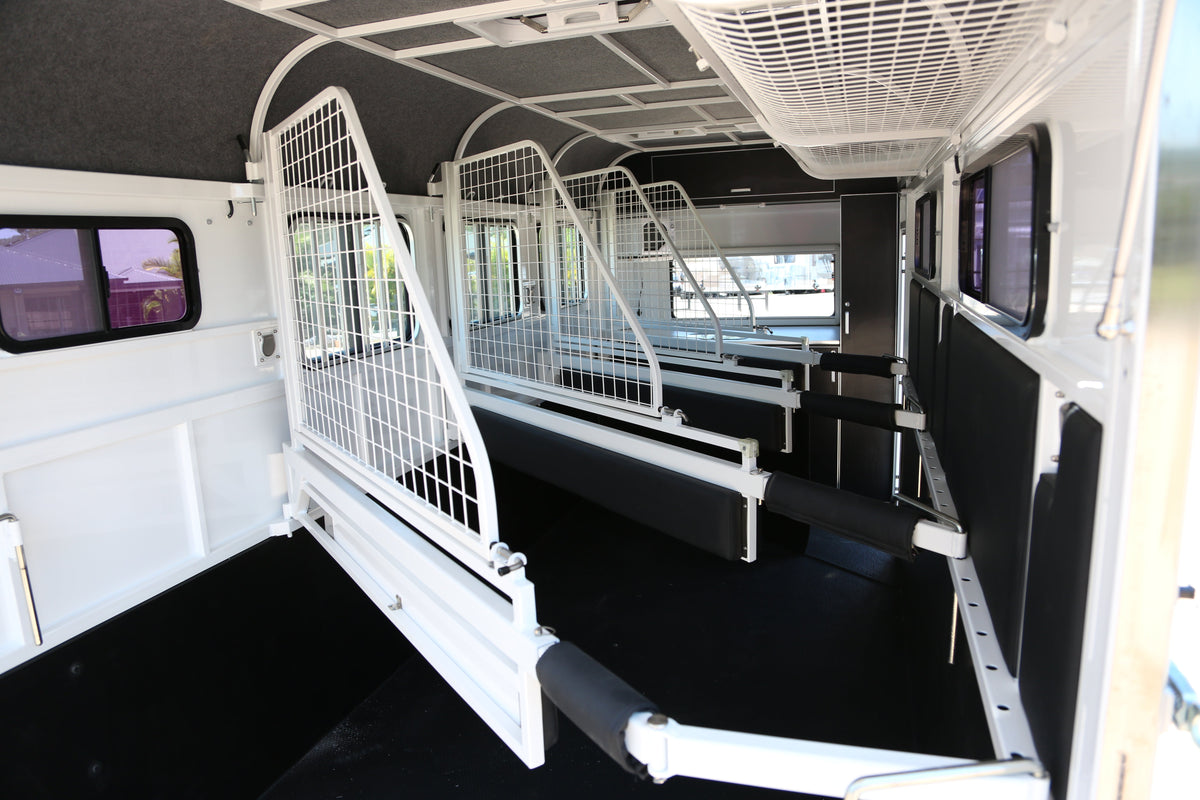
Horse float dividers separate horses and help define the space available in each bay. Straight load floats generally have a centre divider, while angle load floats use dividers between horses standing across the float. Some designs have adjustable, telescopic or removable sections, but their operation varies by model. For larger horses and warmbloods, check the usable bay length, width, height and divider position together. A horse's height in hands doesn't guarantee a fit. Inspect the actual arrangement before choosing a float.
In this guide10 sections
- What do horse float dividers actually do?
- What types of horse float dividers are there?
- How do dividers differ across EuroFloat models?
- Do larger horses and warmbloods need different dividers?
- Which EuroFloat models have longer or wider horse bays?
- Can you remove a divider when travelling with one horse?
- How can you tell if a divider arrangement suits your horse?
- What should you check when inspecting a horse float divider?
- Which divider and bay setup would I choose for a bigger horse?
- Questions buyers ask
G'day, Wes here. When someone has a big horse, the conversation usually starts with bay size. That's important, but I also want them to look at the dividers. The way a divider sits, moves and locks can make a real difference to the space a horse has to stand in.
What do horse float dividers actually do?
A divider separates the horse spaces inside a float. It helps establish where each horse stands and forms part of the float's loading and travelling arrangement.
In a 2 horse straight load, you'll generally have a centre divider between the two horses.
In an angle load, the dividers separate horses standing at an angle across the float.
Those layouts are different, so you shouldn't compare dividers without looking at the rest of the horse bay.
A divider needs to do more than look solid. It needs to suit the design of the float and remain properly secured while horses are travelling.
Here's what I pay attention to:
- Position. Where does the divider sit in relation to the horse's body?
- Space. How much usable room does it leave within the bay?
- Movement. How is the divider opened, moved or adjusted?
- Padding. What areas are covered, and what might the horse contact?
- Locking. How does the divider stay secured for travel?
- Access. Can the horse be loaded and unloaded using the intended arrangement?
A divider isn't something I'd judge separately from the float. The whole horse area has to work together.
What types of horse float dividers are there?
You'll come across several divider arrangements when looking at horse floats.
Some differences are obvious when you first open the float. Others only become clear when you see how everything moves.
Here's a simple overview.
| Divider type | How it generally works | What to check |
|---|---|---|
| Straight load centre divider | Separates the two forward-facing bays | Position, padding and secure attachment |
| Standard angle load divider | Separates horses standing at an angle | Bay clearance and locking |
| Telescopic divider | Includes a section designed to extend or retract | Adjustment, locking and permitted positions |
| Adjustable divider | Has manufacturer-defined adjustment positions | Usable space and secure settings |
| Full-height divider | Extends through more of the horse's standing area | Clearance, ventilation and intended use |
| Half-height divider | Leaves more open space above or below part of the barrier | Suitability for the horse and float design |
| Removable divider | Can be taken out where the manufacturer permits | Approved configuration and safe storage |
Different manufacturers may use different names for similar arrangements.
Also, a divider described as adjustable doesn't mean it can be moved into any position you like. There will be limits to how it is designed to operate.
Some dividers swing open. Others slide or use telescopic sections. Check the instructions for the actual float.
Never assume a divider can be removed, shortened or repositioned simply because doing so appears to create more room.
How do dividers differ across EuroFloat models?
Our range uses different divider arrangements depending on the type of float.
For straight loads, there is a centre divider separating the horse bays.
Classic models have standard dividers.
Prestige angle load models have telescopic dividers, while our Overnighters and goosenecks have adjustable and telescopic dividers.
The Overnighters and goosenecks also have a roll-back dividing wall.
That gives you a few different arrangements to consider, but the important thing is to inspect the particular model you're looking at.
| EuroFloat range | Divider arrangement |
|---|---|
| 2 horse straight loads | Centre divider |
| Classic models | Standard dividers |
| Prestige angle loads | Telescopic dividers |
| Overnighters | Adjustable and telescopic dividers, plus roll-back dividing wall |
| Goosenecks | Adjustable and telescopic dividers, plus roll-back dividing wall |
Those are the listed features. They aren't instructions to change a divider configuration while a horse is travelling.
What I'd do at a showroom is have the divider arrangement explained, then look at the bay with the divider secured in its normal travelling position.
It's easy to look at an open horse area and think there's plenty of room. What matters is the space available once everything is correctly set up.
I'd also look at how easy it is to use the divider during normal loading and unloading.
Do larger horses and warmbloods need different dividers?
Not necessarily a different type, but they may need a different amount or arrangement of space.
A warmblood can be quite different in build from another horse of the same height. One may be broader through the shoulder, while another is longer through the body.
That's why I don't like choosing a float from a height-in-hands claim alone.
I'd look at the horse's whole standing position.
Consider these points:
- Body length. Is the horse standing comfortably between the intended boundaries?
- Shoulder and barrel width. Is there suitable space beside the divider?
- Head and neck. Can the horse stand naturally within the layout?
- Divider contact. Are the padded areas appropriate for where the horse may lean?
- Balance. Can the horse adopt a normal, stable stance without being crowded?
- Temperament and experience. Is the horse accustomed to this type of loading arrangement?
A divider that suits one horse might not suit another, even if both measure the same height.
If your horse has previously shown signs of distress or difficulty travelling, I'd want that properly assessed rather than assuming a bigger bay will automatically solve it.
The goal isn't simply to find the longest float. It's to find an arrangement that works for the individual horse.
Which EuroFloat models have longer or wider horse bays?
We have different bay dimensions across the range, and it's worth looking at them alongside the divider arrangements.
A longer bay and a wider bay aren't the same thing. The layout can make a difference to which measurement is more useful for your horse.
Here are some examples from our listed model specifications.
| EuroFloat model | Bay length | Bay width | Internal height |
|---|---|---|---|
| 2 Horse Straight Load S RN Classic | 1,900 mm | 700 mm | 2,200 mm |
| 2 Horse Straight Load Camper L600 WB SN | 2,100 mm | 900 mm | 2,250 mm |
| 2 Horse Angle Load S SN Classic | 2,400 mm | 800 mm | 2,250 mm |
| 2 Horse Angle Load S Plus SN | 2,600 mm | 800 mm | 2,250 mm |
| 3 Horse Transporter SN | 2,500 mm | 800 mm | 2,250 mm |
| Ultimate Overnighter 2.1 | 2,600 mm | 800 mm | 2,250 mm |
These figures are as listed on our website.
The Straight Load Camper L600 WB SN has a listed bay width of 900 mm. That's wider than the other examples in the table, but its bay is shorter than those of the longer angle load models.
The Angle Load S Plus SN and Ultimate Overnighter 2.1 both have listed bays of 2,600 mm by 800 mm.
Those figures give you a starting point, not a guarantee that a particular horse will fit.
You need to look at how the horse actually stands in the bay and how the divider affects the available space.
Our horse float dimensions guide explains the measurements in more detail.
Can you remove a divider when travelling with one horse?
Some horse floats have divider arrangements that the manufacturer permits owners to remove or reposition.
That can create a different layout when the float is being used for one horse, but it isn't something to improvise.
Removing a divider changes the horse's available space and may affect how the horse can move and balance.
It doesn't automatically make the float more suitable.
Before changing anything, I'd want to know:
- Does the manufacturer approve this configuration for travel?
- How is the horse meant to be positioned and secured?
- Are the remaining bars and fittings suitable for that arrangement?
- Does changing the divider affect loading or unloading?
- Where is the removed divider safely stored?
- Does the new loading arrangement affect weight distribution?
If the manufacturer hasn't approved the setup, don't assume it's safe.
And don't modify a divider yourself just because your horse seems to need more room.
When you're loading one horse, the correct arrangement depends on the float's design and loading instructions.
For practical loading advice, read our loading and unloading guide.
How can you tell if a divider arrangement suits your horse?
Start by looking at the space with every divider in its normal travelling position.
Don't just measure an empty bay with everything opened up.
Think about where the horse's shoulders, body and hindquarters will be when standing inside.
I'd also consider how the horse enters and leaves the bay.
A layout can have suitable standing dimensions but still present a loading arrangement that needs careful handling.
Watch for situations where:
- The horse cannot stand naturally within the intended bay.
- The divider position crowds the horse's body.
- The horse appears uncomfortable with the surrounding fittings.
- The loading arrangement creates unnecessary difficulty.
- The divider doesn't lock correctly.
- Padding is missing or damaged.
- A fitting or edge could contact the horse in an unsafe way.
These are reasons to stop and investigate, not problems to ignore.
Some horses need patient training to become comfortable with floating. Others may have physical discomfort or previous experiences affecting how they behave.
If a horse repeatedly struggles, scrambles or becomes distressed, seek advice from an appropriately qualified equine professional before continuing to transport it.
Don't try to solve every loading or travelling problem simply by moving a divider.
What should you check when inspecting a horse float divider?
If you're comparing floats, take a proper look at the horse area rather than judging everything from outside.
Open and close the dividers using the intended method, with the float stationary and no horse in the bay.
Ask someone to show you how each part operates.
Here's the checklist I'd use:
- Divider type. Understand whether it's standard, telescopic or adjustable.
- Correct position. Check where the divider is intended to sit for travel.
- Locking points. Make sure the locking system operates properly.
- Padding. Look for damage, wear or exposed hard edges.
- Movement. Check that the divider opens and closes as designed.
- Bay clearance. Consider the space available once the divider is secured.
- Horse access. Look at the complete loading and unloading arrangement.
- Condition. Check for damage, loose fittings or repairs that need attention.
- Instructions. Ask about any manufacturer-approved adjustments.
On a second-hand float, I'd pay particular attention to worn hinges, damaged padding and alterations to the original equipment.
If something doesn't operate properly, get it checked before using the float.
For a new float, make sure you understand the divider arrangement during handover. It's much easier to ask questions when the model is sitting in front of you.
Which divider and bay setup would I choose for a bigger horse?
I wouldn't make that decision from the horse's height alone.
I'd start with the bay dimensions, look at the divider arrangement and consider how the horse loads and travels.
If a horse needs more width, I'd compare models with wider bays. If length is the issue, I'd look at models with longer standing areas.
Sometimes a different layout is worth considering. Moving from a straight load to an angle load changes more than the length of the bay.
And if you're carrying two or three horses, you need the arrangement to suit all of them, not just the biggest.
At EuroFloat, you can compare models at our Gold Coast or Melbourne showroom by appointment. Bring your horse's measurements and talk us through how they travel.
I want buyers to understand the actual space and equipment before choosing, rather than relying on a broad claim that a float suits a certain size of horse.
"I love my EuroFloat. It tows like a dream and there is plenty of room for big horses."
Julie, Google review ★★★★★
Questions buyers ask
What is the difference between a straight load and angle load divider?
A straight load generally has a centre divider separating the two forward-facing bays. An angle load uses dividers between horses standing at an angle across the float.
Are telescopic horse float dividers adjustable?
Telescopic designs include sections that extend or retract, but the permitted movement depends on the particular model. Follow the manufacturer's instructions and check the locking positions.
Do warmbloods need wider horse float bays?
Some warmbloods may need additional width or length because of their individual build. Breed and height alone don't determine the right bay; compare the actual horse with the actual float.
Can I remove a horse float divider for one horse?
Only where the manufacturer permits that travelling arrangement. Removing a divider can change the horse's available space and loading conditions, so don't assume it's automatically suitable.
What divider types does EuroFloat use?
EuroFloat straight loads have a centre divider, Classic models have standard dividers, Prestige angle loads have telescopic dividers, and Overnighters and goosenecks have adjustable and telescopic dividers with a roll-back dividing wall.
Does a larger float always have larger horse bays?
No. A larger float may carry more horses or have additional equipment without giving each horse a bigger bay. Check the listed dimensions for the specific model.
Check the space before you choose
Compare real EuroFloat bay dimensions and divider arrangements to find a layout that suits your horses.


Bay dimensions are as listed in October 2026. Divider arrangements and measurements do not guarantee suitability for an individual horse. Follow the manufacturer's instructions and seek qualified advice where needed.
