

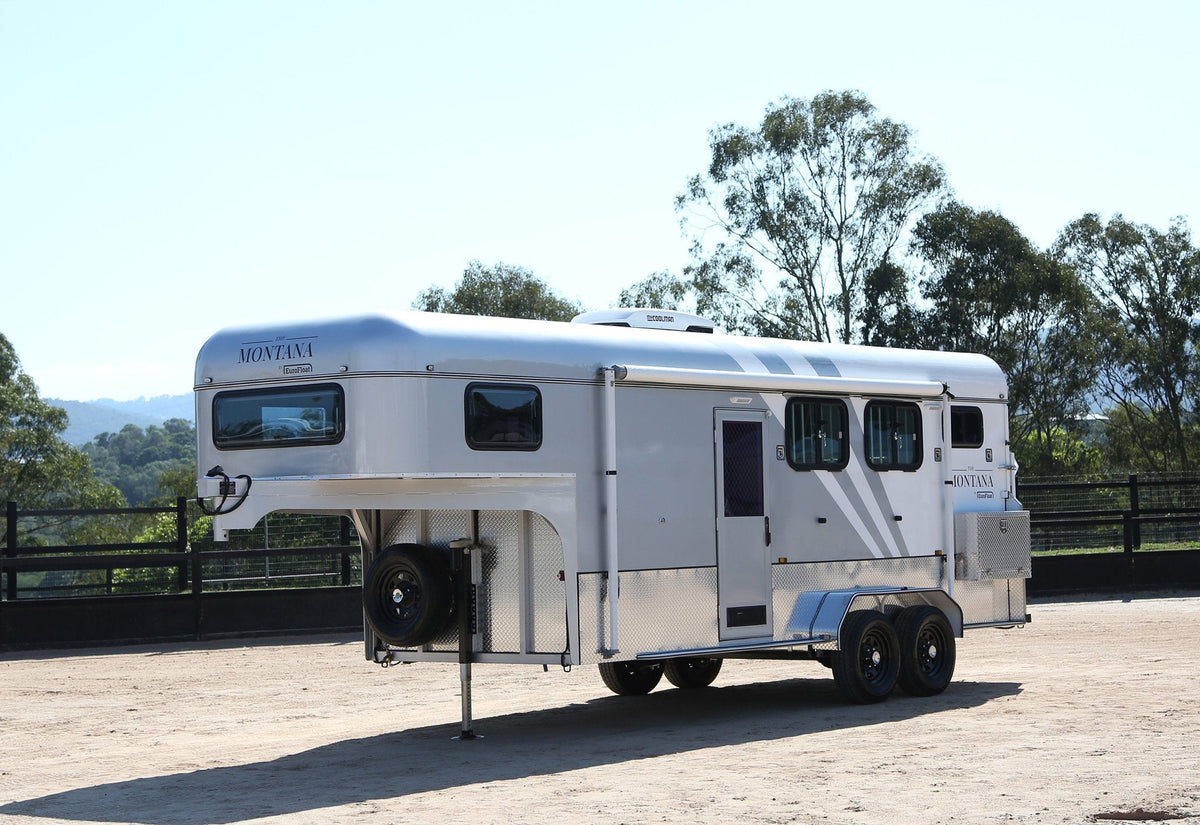
Gooseneck vs bumper pull comes down to how the float connects to your vehicle, what you're carrying and the towing setup you have. Bumper pull is the American name for a conventional ball-coupled float, which is what most Australians tow. A gooseneck connects to a hitch mounted in the tray of a suitable ute or truck, placing more of the trailer's load over the tow vehicle's rear axle area. Both can carry horses safely when properly matched, loaded and maintained. Neither suits every vehicle or rider.
In this guide9 sections
- What's the difference between a gooseneck and a bumper pull horse float?
- What vehicle do you need to tow a gooseneck?
- How do gooseneck weights and prices compare with conventional floats?
- Does a gooseneck tow differently from a conventional horse float?
- Which arrangement works better for camping and staying at shows?
- Is a gooseneck harder to own or set up?
- Gooseneck or conventional float: which suits your situation?
- What should you check before buying either type?
- Questions buyers ask
G'day, Wes here. People often ask me whether they should buy a gooseneck or a conventional horse float. They both do the same basic job, but they connect to your vehicle differently. Before choosing either one, I want you to think about your horses, your towing vehicle and how you'll actually use the float.
What's the difference between a gooseneck and a bumper pull horse float?
Let's clear up the names first. Bumper pull is an American term. Here in Australia, we'd normally say a conventional horse float, or a ball-coupled float.
A conventional float connects to a rated towball and towbar at the back of the towing vehicle. That's the arrangement most Australian horse owners are familiar with.
A gooseneck uses a different connection. The front section extends over the towing vehicle's tray and couples to a dedicated gooseneck hitch mounted in the tray.
That changes the way the trailer's coupling load is carried by the tow vehicle.
- Conventional float. The coupling load acts at the towbar behind the vehicle.
- Gooseneck. The coupling sits over the vehicle's tray, closer to the rear axle area.
- Vehicle choice. Each arrangement needs a suitable vehicle and correctly rated towing equipment.
- Float size. Both arrangements come in different layouts, capacities and equipment levels.
You can't decide which one will suit you just by looking at the shape. You need to consider the complete vehicle and float combination.
The other thing worth knowing is that a gooseneck isn't simply a conventional float with a different coupling fitted. It's a different towing arrangement that needs to be considered from the start.
What vehicle do you need to tow a gooseneck?
A gooseneck needs a suitable ute or truck with a properly installed and rated hitch in its tray. You can't hook it onto the ordinary towball behind a vehicle.
The vehicle also needs to be rated for the trailer and the load imposed through the gooseneck connection.
This is where I see people get caught up in advertised towing figures. A vehicle might have a towing rating that sounds suitable, but that isn't enough information on its own.
You also need to check:
- Towing capacity. The vehicle manufacturer's rating for the particular towing arrangement.
- GCM. The maximum permitted combined mass of the vehicle and trailer.
- GVM. The maximum permitted mass of the loaded towing vehicle.
- Hitch rating. The gooseneck hitch and its installation must be rated for the job.
- Coupling load. The weight carried through the gooseneck affects the towing vehicle's available payload.
- Actual loaded weight. Horses, water, equipment and upgrades all contribute.
The same principle applies to a conventional float. A large towing capacity doesn't automatically mean the combination complies with every limit.
Before choosing a vehicle or hitch, read what can tow a horse float.
If you're unsure about your licence or the rules that apply to your situation, check the relevant state authority. Our horse float licence guide is another starting point.
How do gooseneck weights and prices compare with conventional floats?
It's important to compare actual models rather than assuming every gooseneck is heavier or more expensive than every conventional float.
A basic float and a camper float with living accommodation aren't doing exactly the same job.
Here are examples from our range, as listed on the EuroFloat website in October 2026. Prices exclude delivery.
| EuroFloat model | Hitch type | Price | Tare | ATM |
|---|---|---|---|---|
| 2 Horse Angle Load S SN | Conventional | $25,990 | 1,700 kg | 3,500 kg |
| 3 Horse Transporter SN | Conventional | $29,990 | 1,975 kg | 3,800 kg |
| Compact Overnighter 2.1 | Conventional | $41,990 | 2,100 kg | 3,500 kg |
| 2 Horse Gooseneck Camper SN 2.1 | Gooseneck | $69,990 | 2,700 kg | 4,200 kg |
| 3 Horse Gooseneck Camper SN 3.1 | Gooseneck | $74,500 | 2,900 kg | 4,500 kg |
You'll notice quite a difference in price and weight between these examples. Some of that comes down to the type of float and the equipment it carries, not just the hitch.
Our 2 Horse Gooseneck Camper SN 2.1 has listed overall dimensions of 7,923 mm long, 2,480 mm wide and 2,670 mm high. That gives you an idea of the overall space you need to consider when storing or moving this particular model.
Don't use those dimensions for another gooseneck. Each model needs to be checked individually.
A tare figure is also only the starting point. Once you've added your horses, supplies, water and equipment, the actual loaded weight changes.
Read our horse float weight guide if you want to understand tare, ATM and payload before comparing models.
Does a gooseneck tow differently from a conventional horse float?
Yes, because the position of the coupling changes how the trailer interacts with the towing vehicle.
With a conventional float, the coupling is behind the vehicle. With a gooseneck, it sits over the tray, closer to the rear axle area.
That difference can affect how the combination turns, reverses and responds to loading.
But I wouldn't tell you that one arrangement will always tow better than the other. The vehicle, float, tyres, suspension, weight distribution and road conditions all play a part.
Here's what matters with either arrangement:
- Correct loading. Keep within the permitted weights and follow the manufacturer's loading instructions.
- Suitable towing vehicle. Check all the relevant ratings, not just one number.
- Proper hitching. Use the correct coupling and check that everything is secured.
- Condition of the float. Tyres, brakes and running gear need regular attention.
- Driver experience. Take time to understand how your particular combination behaves.
A gooseneck can feel different to reverse because the pivot point is in a different position. If you're used to a conventional float, don't assume it will react exactly the same way.
Take your time getting familiar with the combination in a suitable area before setting off with horses.
For either type, smooth driving, sensible speed and a consistent pre-tow routine matter more than making big claims about how a particular float handles.
Which arrangement works better for camping and staying at shows?
This is often where the conversation moves from the hitch to the way people use their float.
Some riders want somewhere to carry two horses and their show gear for the day. Others spend several nights away and want more living equipment.
You can get camper and living options in conventional floats, so you don't automatically need a gooseneck to stay overnight.
The things I'd think about are:
- How often you stay away. A day trip is different from several nights at a competition.
- How many horses travel. Make sure the horse capacity suits your regular trips.
- What you take with you. Tack, feed, water and camping supplies all need somewhere to go.
- Living arrangements. Check what equipment is fitted and how much space it leaves.
- Power and water. Understand how the fitted equipment operates before buying.
- Parking and access. Think about where the combination will sit at home and at events.
Our gooseneck campers have living arrangements, and our Overnighter range provides another option for riders who want accommodation without moving to a gooseneck hitch.
It's worth looking at the layouts side by side. See our horse floats with living before deciding which arrangement suits your weekends away.
Is a gooseneck harder to own or set up?
The main difference is the towing setup you need before you can use it.
A conventional float uses a suitable rated towbar and ball coupling. A gooseneck requires a suitable tray-mounted hitch and compatible towing vehicle.
That affects more than the initial purchase.
Think about what happens when you change vehicles, arrange servicing or need to park the combination.
For a gooseneck, I'd want answers to these questions:
- Can the proposed vehicle legally and safely tow the loaded gooseneck?
- Is the tray and hitch arrangement suitable and professionally installed?
- Who can inspect and maintain the coupling equipment?
- Will the combination fit where you normally store it?
- Can you access the places you regularly attend with horses?
- What happens if you change your towing vehicle later?
I'd ask similar questions about a conventional float, particularly if you're buying a larger model.
The cost of the float is only one part of the decision. The vehicle and towing equipment need to be included in your planning.
There's no advantage in choosing a float you love if the rest of the setup doesn't work for you.
Gooseneck or conventional float: which suits your situation?
There's no one answer that works for every rider. I'd start with your normal use and narrow it down from there.
| Your situation | What I'd consider first |
|---|---|
| Regular day trips with one or two horses | Conventional 2 horse float |
| Three horses travelling regularly | Compare 3 horse conventional and gooseneck models |
| Staying overnight with two horses | Conventional camper, Overnighter or gooseneck |
| Already own a suitable gooseneck-rated vehicle | Compare gooseneck layouts and actual loading limits |
| Only have a conventional towbar setup | Check conventional options before considering vehicle changes |
| Limited storage space at home | Compare overall dimensions and access requirements |
| Planning to change towing vehicles | Confirm the future towing arrangement before buying |
These are starting points, not automatic recommendations.
I would also think about what you're likely to do over the next few years. If you currently travel with two horses but expect to carry three regularly, that may change which models are worth looking at.
On the other hand, buying a larger float for a trip you might take once isn't always worthwhile.
The aim is to end up with a float that works for your horses and the vehicle you'll actually use.
What should you check before buying either type?
Once you've narrowed down the layout, look closely at the individual models.
Don't compare a basic conventional float with a fully equipped gooseneck and assume the price difference is purely about the hitch.
I would compare:
- The number of horses and the usable bay dimensions.
- Tare, ATM and the actual loaded weight allowance.
- The towing vehicle and coupling requirements.
- Standard equipment and any upgrades.
- Living space, storage and access.
- Overall length, width and height.
- The full quoted purchase and delivery price.
- Warranty coverage and ongoing servicing requirements.
At EuroFloat, we have showrooms on the Gold Coast and in Melbourne, with visits by appointment. You can compare models and arrange a test tow of a suitable float behind your own vehicle.
We're Australian owned and operated, and I'd rather help you work through the towing setup properly than have you buy something that doesn't suit your needs.
Questions buyers ask
What does bumper pull mean in Australia?
It's the American name for a conventional trailer coupled to a towball behind the towing vehicle. Most Australian horse owners simply call it a horse float or a ball-coupled float.
Can I tow a gooseneck with an ordinary ute?
Only if the particular ute and its properly installed gooseneck hitch are rated for the loaded trailer and all other limits are met. An ordinary rear towball isn't suitable for coupling a gooseneck.
Is a gooseneck more stable than a conventional float?
The coupling position changes the way the trailer's load acts on the vehicle. Actual stability depends on the complete combination, its loading, condition and driving, so don't assume one type is automatically safer.
Do I need a different licence for a gooseneck?
Licence requirements depend on the vehicle, the combination and the applicable jurisdiction. Check the relevant transport authority rather than assuming the hitch type alone decides your licence.
Can I get a conventional horse float with living?
Yes. EuroFloat has conventional camper and Overnighter models with living arrangements. A gooseneck isn't the only option for staying away at shows.
Can I test tow a EuroFloat before buying?
Yes. EuroFloat offers test towing behind your own suitable vehicle at its Gold Coast and Melbourne showrooms, by appointment.
Compare the right float for your vehicle
Look at conventional and gooseneck models, then work out which arrangement suits your horses and towing setup.


Prices and specifications are as listed in October 2026 and exclude delivery. Check the actual float's identification plate, the vehicle manufacturer's ratings and applicable towing rules before travelling.
