

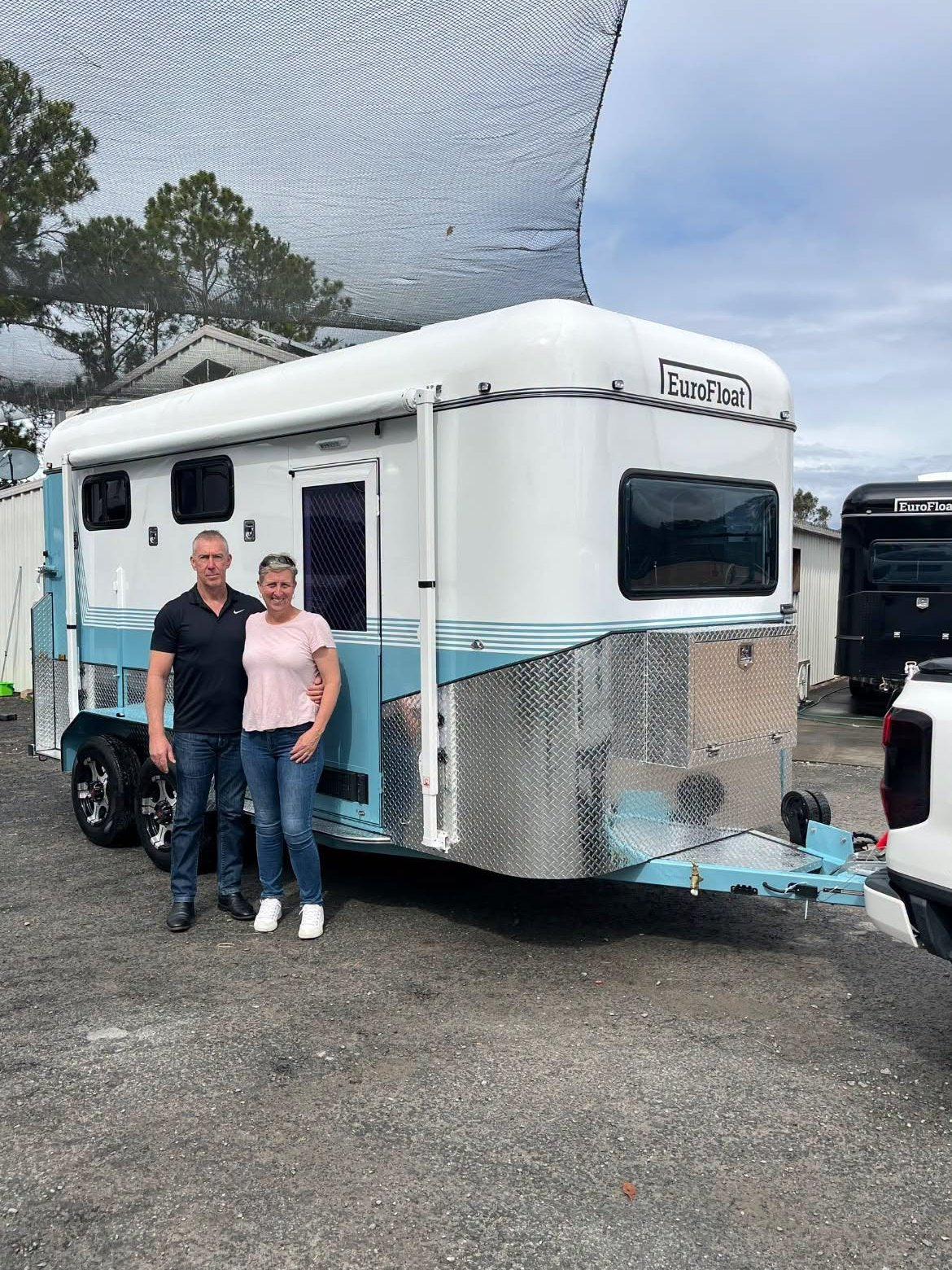
The best horse floats in Australia aren't decided by a brand ranking. The right float is one that suits your horses, can be towed within your vehicle's limits and gives you clear information before you buy. Compare usable bay space, actual tare and ATM, floor and construction details, included equipment, drive-away price, warranty terms and service support. Check real owner reviews, then inspect and test tow a suitable float where possible. A float that works for one rider may be the wrong choice for another.
In this guide9 sections
- What do buyers mean by “best horse floats in Australia”?
- Which float layout suits your horses and the way you travel?
- How do real tare and ATM figures affect the decision?
- How can you check the floor and build before buying?
- What's included in the price, and what will you pay altogether?
- What do warranty terms and after-sales support tell you?
- How useful are reviews and a test tow?
- Why would I consider EuroFloat?
- Questions buyers ask
G'day, Wes here. People ask which horse float they should buy, and I always come back to the same thing: tell me about your horses first. A float can look terrific in photographs and still be wrong for the way you travel. I'd rather help you work out what matters before you compare brands.
What do buyers mean by “best horse floats in Australia”?
Usually they're asking which float will suit their horses and give them confidence about the purchase. That's a more useful question than looking for one winner across every rider and every budget.
A float for one horse travelling to local lessons doesn't have the same job as a float taking three horses and a family's camping equipment to competitions. The right layout, weight and equipment can be quite different.
I would narrow the decision down to a few things you can actually check:
- Horses. How many travel, and what space do they need?
- Vehicle. Can you legally and safely tow the loaded float?
- Layout. Do you need a straight load, angle load, camper float or horse float with living?
- Construction. What is underneath the mats and behind the fittings?
- Price. What will the completed purchase actually cost?
- Support. Who will help with servicing, parts and warranty matters later?
I've written a separate guide to comparing horse floats with a worksheet you can use between models. This guide is about deciding which answers should matter to you in the first place.
Which float layout suits your horses and the way you travel?
Start with the number of horses you regularly take away, not the number you might occasionally carry. A family taking two horses to lessons has different needs from one travelling to events with three.
Then look at the horse bays. Height in hands is useful, but it doesn't tell you how broad or long a horse is, or how comfortably it stands within a particular layout.
I'd ask these questions before choosing a model:
- How many horses? Choose for the number you actually travel with.
- How much usable room? Check the bay length, width and internal height of the actual float.
- How are they loaded? Compare straight load and angle load arrangements.
- How do the dividers work? Look at their normal secured position and padding.
- How long are your trips? Day trips and nights away call for different equipment.
- Where do you park? Check whether the whole float fits at home and at your destinations.
Don't assume a 3 horse float gives every horse a bigger bay than a 2 horse float. It's another horse space, and the dimensions still need checking.
How do real tare and ATM figures affect the decision?
Weights are one area where I don't want buyers guessing. Two floats can look similar but have different empty weights and permitted loaded weights.
Tare is the float's weight under the maker's stated empty conditions. ATM is the maximum permitted loaded trailer mass, including the load transferred to the tow vehicle through its coupling.
Your horses, water, tack and fitted upgrades all need to be considered. Then you must check the towing vehicle's limits separately.
Here are a few different EuroFloat models, with prices and figures as listed in October 2026. Prices exclude delivery.
| EuroFloat model | Horse spaces | Tare | ATM | Listed price |
|---|---|---|---|---|
| 2 Horse Straight Load S RN Classic | 2 | 1,265 kg | 2,950 kg | $15,990 |
| 2 Horse Angle Load S SN | 2 | 1,700 kg | 3,500 kg | $25,990 |
| 3 Horse Angle Load Transporter SN | 3 | 1,975 kg | 3,800 kg | $29,990 |
| Ultimate Overnighter 2.1 | 2 | 2,400 kg | 3,950 kg | $43,990 |
These examples aren't a ranking. They show how different layouts and equipment change what you're comparing.
The compliance plate on the actual float is what counts. If you've added equipment, have the finished weight and loaded combination checked rather than assuming the website tare covers everything.
For a closer explanation, see horse float weights: what your float really weighs.
How can you check the floor and build before buying?
A floor needs more attention than the rubber mat sitting on top of it. Ask what the underlying floor is made from, how you can inspect it and what cleaning it needs.
Timber can deteriorate if moisture is trapped. Aluminium doesn't rot like timber, but it still needs proper cleaning because contaminants and retained moisture can contribute to corrosion. Other floor systems need to be judged against their actual maker's specifications.
Take a proper look through the horse area rather than stopping at the outside paintwork.
- Floor. Ask to see underneath the mats and understand the support arrangement.
- Dividers. Look for secure locking, suitable padding and normal operation.
- Doors and ramp. Open and close them using the intended method.
- Ventilation. Check the fitted openings and how they operate during travel.
- Hardware. Inspect catches, fittings and the general finish.
- Electrical equipment. Ask who fitted it and how you're meant to operate and maintain it.
What's included in the price, and what will you pay altogether?
The price on an advertisement is a starting point. When comparing floats, find out what's included on the exact model and what will appear as an extra on the final quote.
A lower advertised price doesn't mean much if you're comparing a basic layout with another float that has living equipment or added upgrades. Match the models to your needs before deciding whether a quote makes sense.
Ask each seller to separate the figures clearly:
- Float price. Which specific model and equipment package is quoted?
- Standard inclusions. What comes with that model without added upgrades?
- Optional equipment. What do the extras cost and add to the weight?
- Delivery. What does it cost to get the float to your area?
- Registration. Is any registration included, and what paperwork is involved?
- Deposit and balance. When do you pay, and on what terms?
- Changes. What happens if you alter your order before delivery?
I'd ask for the complete quoted amount rather than comparing two advertised starting figures. That helps you see the real difference between the floats you're considering.
Our horse float prices guide covers the purchase costs in more detail.
What do warranty terms and after-sales support tell you?
A warranty matters, but the number of years isn't enough by itself. You need to understand which parts are covered, the conditions and how a claim is handled.
Ask for the current terms before paying a deposit. Look for exclusions, servicing requirements, when coverage begins and what information you'll need if something goes wrong.
I'd also ask a few practical questions about ownership after the sale:
- Servicing. Who can carry out the required work, and how often?
- Records. What documents must you keep?
- Parts. Who can help you source replacement components?
- Repairs. Where do you turn if a latch, door or mechanical part needs attention?
- Claims. How do you report a problem, and what are the timeframes?
- Support. Is there a real point of contact after collection?
At EuroFloat, every new float has a 2-Year Warranty covering the specified components, together with an 11-Year Aluminium Flooring System warranty. Conditions apply and both begin on the day you pick up the float.
The requirements include servicing at least every 12 months by a qualified mechanic, keeping records and reporting defects within 10 days with clear photographs. I would expect any buyer to compare those terms with the current terms for whatever float they're considering.
How useful are reviews and a test tow?
Reviews can tell you about experiences after the sale, not just what a float looked like on collection day. I'd read a range of genuine reviews and pay attention to comments about service, ownership and how the float tows.
Check when reviews were written and whether the details are relevant to the model you're considering. Then inspect the float yourself. Look at the horse bays, doors, ramp, dividers and equipment before making a decision.
Where a suitable test tow is available, use it. Confirm the towing combination first, then pay attention to how the float behaves with your own vehicle under the test conditions.
Don't treat a short test tow as proof of how the float will behave with different horses, loads and road conditions. It's another piece of information alongside the specifications and ownership terms.
If you're looking for a separate overview of brands and models, read our Australian horse float brand round-up. Make your decision from the evidence for the float you're actually buying.
Why would I consider EuroFloat?
We're Australian owned and operated, with showrooms on the Gold Coast and in Melbourne. We've been selling horse floats in Australia since 2014, and over 350 horse owners a year buy a EuroFloat.
Every EuroFloat has 25 mm reinforced aluminium floor panels, and every new one comes with our 2-Year Warranty and 11-Year Aluminium Flooring System warranty. Conditions apply, and both start when you pick up your float.
We've also got our own service centre for servicing, repairs, warranty and parts. Our Google rating is 4.8 stars, and you're welcome to read the actual customer reviews rather than take my word for it.
You can see our horse floats for sale, inspect models by appointment and arrange to test tow a suitable float behind your own vehicle. I'd rather have you ask questions than buy something that doesn't suit your horses.
"Working with Wes made the experience outstanding."
Danielle Scaroni, Google review ★★★★★
Questions buyers ask
What makes the best horse float for you?
The one that suits your horses, your tow vehicle, your budget and the way you travel. Check usable space, actual weights, equipment, warranty and support rather than a brand ranking.
Should I buy a straight load or angle load float?
Compare the way your horses load and stand, plus the individual bay dimensions. Neither layout is automatically right for every horse.
Do I need a 3 horse float for two big horses?
Not necessarily. A third bay doesn't automatically provide more space in each bay. Compare the usable dimensions and the intended loading arrangement.
How do I know whether my vehicle can tow the float?
Check the loaded trailer mass against the vehicle's towing capacity, GVM, GCM, towbar and coupling limits. Don't decide from the vehicle's advertised towing figure alone.
What should I ask about a horse float warranty?
Ask what is covered, what is excluded, when it starts, how claims are made and what servicing records you need to keep.
Can I test tow a EuroFloat before buying?
Yes. You can arrange a test tow behind your own suitable vehicle at our Gold Coast or Melbourne showroom by appointment.
Compare the details that matter to you
Start with your horses and vehicle, then inspect the layouts, weights and equipment before choosing.


Model figures and prices are as listed in October 2026; prices exclude delivery. Check the actual float, current warranty terms and vehicle towing limits before purchasing.
