

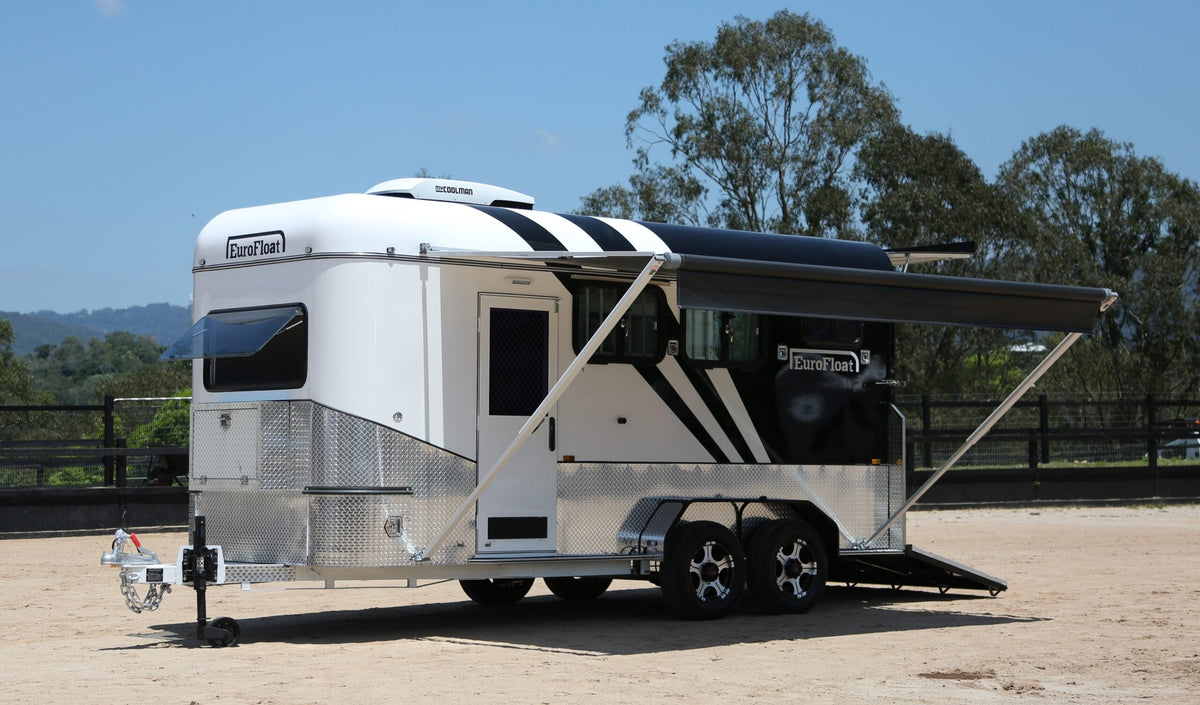
Horse float awnings give you a covered area beside your float for shade, light rain and everyday use at shows or campgrounds. Wall-mounted awnings attach to the side of a suitable float, roof-mounted awnings fit higher on the body, and electric awnings use powered operation. The right choice depends on your float, how often you'll use it and the available mounting space. Always check compatibility before ordering, and roll the awning in when conditions turn windy or you're leaving the float unattended.
In this guide10 sections
- What does a horse float awning actually do?
- What's the difference between wall-mounted and roof-mounted awnings?
- Which awnings are available on EuroFloat models?
- Is an electric horse float awning worth considering?
- How useful is an awning at horse shows?
- What should you consider when choosing an awning for camping?
- How do you set up and pack down a horse float awning safely?
- What should you check before fitting an awning?
- How many EuroFloat buyers choose an awning?
- Questions buyers ask
G'day, Wes here. If you've spent a whole day at a horse show standing beside your float in the sun, you'll understand why people ask about awnings. They're useful for camping too. But there are different types, and I want you to know what you're getting before adding one to your float.
What does a horse float awning actually do?
A horse float awning creates a covered area beside the float. It's somewhere to get out of direct sunlight, organise your gear or sit for a while between classes.
At a show, that can make the day more comfortable. Instead of leaving everything exposed beside the float, you've got a defined area to work from.
For camping, it's useful when you're spending longer periods beside the float and want a covered outdoor space.
There are a few things I think an awning does particularly well:
- Shade. Provides cover from direct sunlight when positioned appropriately.
- Show preparation. Gives you somewhere to organise equipment beside the float.
- Light rain. Offers some shelter when the weather and manufacturer's instructions allow.
- Camping. Creates an outdoor area for sitting and everyday activities.
- Convenience. Keeps the covered area close to the float rather than requiring a separate shelter.
An awning isn't designed to replace a proper shelter in severe weather. Strong wind and heavy rain can damage the awning or its mounting equipment.
It's also not somewhere I'd leave equipment unsecured and assume everything will stay protected.
Think of an awning as an addition to your normal show or camping setup. Used properly, it's handy. Used carelessly in bad weather, it can become a problem.
What's the difference between wall-mounted and roof-mounted awnings?
The main difference is where the awning attaches to the float. That affects the installation, how it sits against the body and which models it may suit.
A wall-mounted awning attaches to a suitable mounting area on the side of the float. A roof-mounted awning sits higher, using an approved mounting arrangement.
Both can provide useful cover. I wouldn't choose between them based on appearance alone.
| Awning type | How it works | What to consider |
|---|---|---|
| Wall-mounted | Attaches to the side of a suitable float | Mounting location, body clearance and approved fit |
| Roof-mounted | Attaches higher on the float using suitable mounting hardware | Roofline, mounting points and height clearance |
| Electric | Opens and closes using a powered mechanism | Power supply, controls, maintenance and safe operation |
The fit is important because floats have different body shapes, doors, windows and rooflines. A mounting position that works on one model may not work on another.
You also need to think about how the awning sits when packed away. Make sure it doesn't interfere with anything you need to use on the float.
An electric awning is about convenience of operation. It still needs the same care when setting up, securing and packing away.
Don't assume that powered operation makes an awning suitable for stronger wind or different weather conditions.
Which awnings are available on EuroFloat models?
We offer wall-mounted, roof-mounted and electric awning upgrades. Which one can be fitted depends on the float you're ordering.
Here are our listed upgrade prices for October 2026.
| EuroFloat awning option | Mounting and operation | Listed price |
|---|---|---|
| Carefree awning | Wall-mounted, manual operation | $1,795 |
| Fiamma awning | Roof-mounted | $1,995 |
| Electric Carefree awning | Electric, wall-mounted | $2,290 |
These are upgrade prices, not prices for an entire float.
Our order records show that straight load buyers have selected the Fiamma roof-mounted awning on L400, L500 and L600 models.
The Carefree wall-mounted awning has been selected on angle loads and Overnighters.
That doesn't mean every awning fits every float in those ranges. The exact model and mounting arrangement need checking.
I wouldn't want you ordering an awning simply because you've seen one on another owner's float.
If you're looking at a particular EuroFloat, ask us which awning fits that model and what the installation involves.
You can view our horse float upgrades to compare the available options.
Is an electric horse float awning worth considering?
An electric awning is worth looking at if you regularly set up beside your float and would prefer powered operation.
The electric Carefree awning in our range is a wall-mounted option. It's not a separate roof-mounted design.
The main attraction is being able to extend and retract the awning using its electric mechanism rather than operating it entirely by hand.
But I always tell people to think beyond how it opens.
Ask yourself:
- How often will you use it? Occasional show days and regular camping are different situations.
- Where will the power come from? Understand the requirements for the exact system.
- How is it controlled? Have the normal operating procedure demonstrated.
- What happens if power is unavailable? Ask about the manufacturer's specified procedure.
- How is it secured? Follow the instructions for setting up and using it.
- How will you maintain it? Understand what needs inspecting and cleaning.
Electric operation doesn't remove the need to watch the weather.
You still need to retract the awning when wind becomes a concern, even if you've only just put it out.
I'd choose electric because it suits the way you use the float, not because you expect it to handle conditions that a manual awning can't.
How useful is an awning at horse shows?
Show days can mean long stretches of time beside the float. You might be waiting between classes, getting tack organised or having something to eat.
A covered area makes those parts of the day easier to manage, provided the awning can be used safely in the conditions.
I'd think about the way you normally park at competitions. There may be other floats nearby, vehicles moving through or limited space beside your float.
Before extending an awning:
- Check you've got enough clear space beside the float.
- Look for nearby vehicles, people and overhead obstructions.
- Make sure the ground and setup area are suitable.
- Follow the manufacturer's instructions for support and securing.
- Keep walkways and access around the float clear.
- Watch the weather throughout the day.
- Retract the awning before moving the float.
It's also worth thinking about what sits underneath it.
Chairs, tack and other equipment should be positioned so they don't create problems for people or horses moving around the float.
And if you're packing up quickly after a long day, make the awning part of your normal final checks.
I always prefer a simple pack-down routine. You don't want to be ready to leave and suddenly remember there's still equipment extended beside the float.
Our horse show packing list covers the other things worth checking before heading off to a competition.
What should you consider when choosing an awning for camping?
Camping is a little different from attending a show for the day.
You may be using the awning for meals, sitting outside or spending more time around the float over several days.
That makes the setup and packing routine more important.
Think about where you're likely to camp. A site with limited room, uneven ground or exposed conditions may change how practical an awning is.
I'd plan around these points:
- Space. Make sure the extended awning fits within the area you're using.
- Weather. Think about exposure to wind and rain, particularly overnight.
- Water runoff. Follow the manufacturer's instructions so water doesn't collect dangerously.
- Access. Keep doors, walkways and equipment accessible.
- Packing. Know how to retract the awning quickly if the weather changes.
- Supervision. Don't leave it extended while you're away from the float.
The overnight part deserves particular attention.
I would roll an awning in before leaving the float unattended and whenever windy conditions develop. Don't rely on a forecast staying the same.
An awning also doesn't replace thinking about your horses' own shelter, water and welfare needs while camping.
For more on planning those trips, read our camping with horses guide.
How do you set up and pack down a horse float awning safely?
The exact steps depend on the awning model. Always use the manufacturer's instructions rather than assuming every system works the same way.
Before opening it, look at the weather, the available space and the condition of the equipment.
Then follow the correct operating sequence for the fitted awning.
My general checklist is straightforward:
- Before opening. Check the mounting equipment, awning housing and surrounding area.
- While extending. Make sure nothing obstructs the movement.
- When set up. Use the required supports and securing arrangements.
- During use. Keep watching for wind, rain and anything that might affect the awning.
- Before packing. Clear equipment and people from its operating area.
- When closing. Follow the correct sequence and make sure everything is fully secured.
- Before driving. Confirm the awning is completely retracted and locked for travel.
If an awning is wet when you pack it away, follow the manufacturer's drying and care instructions when conditions allow.
Don't force a mechanism that isn't moving properly. Stop and have the problem checked.
The wind rule is the one I keep coming back to: if it's getting windy, retract the awning. If you're leaving the float unattended, retract it.
That applies whether the awning is manual or electric.
What should you check before fitting an awning?
An awning needs the correct mounting arrangement for the specific float. It isn't something to attach wherever there's a convenient-looking surface.
The installer needs to follow the awning manufacturer's requirements and check compatibility with the float.
I'd ask about:
- Mounting position. Where is the awning designed to attach?
- Approved hardware. What brackets and fittings are required?
- Doors and windows. Will the awning interfere with normal operation?
- Travel position. How does it sit when fully packed away?
- Power. Does the selected system require an electrical supply?
- Maintenance. What parts need regular inspection?
- Weight. What additional mass does the awning add to the float?
That last point is easy to overlook.
An awning is an upgrade, so its weight needs to be included when working out the actual loaded float weight.
If you're comparing different setups, read our horse float weights guide.
The awning also needs to be inspected over time. Check for loose or damaged parts, and arrange repairs if anything isn't operating properly.
How many EuroFloat buyers choose an awning?
They're a popular upgrade in our order records.
Of 259 EuroFloat float orders between October 2025 and October 2026, about a third included an awning. That's 33% of the recorded orders.
Among Overnighter buyers in that same order data, 77% added an awning.
I can understand why. People buying an Overnighter are often thinking about spending more time away with their horses, and a covered outdoor area can be useful.
But those figures don't mean an awning is essential.
Plenty of riders prefer a simpler setup, particularly if they mainly use their float for short trips.
At EuroFloat, I'd rather know what events you attend and how often you camp before suggesting an upgrade.
Choose the awning that suits the float and how you'll use it. Then make sure you understand how to operate and maintain it properly.
Questions buyers ask
What is the difference between a wall-mounted and roof-mounted horse float awning?
A wall-mounted awning attaches to a suitable position on the side of the float, while a roof-mounted awning sits higher. Compatibility depends on the actual float and mounting arrangement.
Can you use a horse float awning in the rain?
An awning can provide cover in light rain when conditions and the manufacturer's instructions permit. Heavy rain and wind can create hazards, so retract it when conditions are unsuitable.
Should you leave a horse float awning out overnight?
Don't leave it extended unattended. Wind and weather can change, so retract it before leaving the float or when conditions become windy.
Can an awning fit any EuroFloat model?
No universal fit is promised. Ask EuroFloat which awning is suitable for the particular model you're considering.
How much does a EuroFloat awning cost?
As listed in October 2026, the Carefree wall-mounted awning is $1,795, the Fiamma roof-mounted option is $1,995 and the electric Carefree wall-mounted awning is $2,290.
Does adding an awning change the weight of my float?
Yes. An awning adds weight, so it must be included when checking the loaded float and available payload.
Make show days and camping more comfortable
Compare awning options with the float you're considering and check which mounting arrangement suits your model.


Awning compatibility, fitting and operation depend on the selected model and manufacturer's instructions. Retract awnings in wind or when unattended. Prices are as listed in October 2026.
